Posts

What is the relation between mastery goals and intrinsic motivation?

Image
Bieg et al. (2016) did a study to clarify the relation between mastery goals and intrinsic motivation. Let's first look at what these two concepts mean. Meaning and importance of mastery goals and intrinsic motivation Mastery goals are focused on developing competence. This is in contrast with performance goals which are focused on demonstrating one's competence in comparison with others. Why are mastery goals important? Because research has shown that they have many positive effects (in comparison with performance goals), such as choosing challenging goals, persistence, more interest, deeper learning, etc. Intrinsic motivation is the desire to do things which are inherently interesting, fun, exciting or otherwise satisfying. Intrinsic motivation is not only fun. It is also important because it is associated with positive emotions, interest, and deep learning.

Portugal decriminalized drugs use and what happened?

Image
Drugs use can have a disruptive effect on lives of individuals and can also lead to many problems at a societal level. In 1971 president Nixon proclaimed a 'War on Drugs' which continues up to today. This war on drugs meant that the production, trade and use of drugs were seen as criminal behavior and were to be fought aggressively by the state. The emphasis in the war on drugs was on punishment and not on treatment of addiction. Has it been successful? Well, no. The annual costs are astronomic (they are estimated to be around $51 billion), prisons are packed and drugs use and all problems that go along with it have only gotten worse. Okay, but if such a strict approach does not work, what else can you do?

Is need for novelty the fourth basic psychological need?

Image
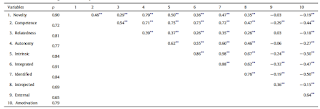
We may need to keep on experiencing new things in order to keep on functioning well and feeling well.  Self-determination theory has identified three basic, innate psychological needs - the need for autonomy, competence, and relatedness - which need to be fulfilled for optimal functioning. In a paper by González-Cutre et al. (2016) preliminary evidence is provided that need for novelty is also a basic psychological need contributing to optimal functioning. In two studies, participants completed a new measure to assess novelty need satisfaction, the Novelty Need Satisfaction Scale (NNSS), measures of psychological needs and regulation styles and psychological well-being.

Trump's words are a clear warning of what he intends to do: turn back civilization

Of the many things that can be held against Donald Trump ( that very many things he says aren't true, his ruthless behavior in business , his many business failures , his unawareness of his own ignorance regarding policy matters , the fact that he's taking bragging to whole new levels, that he promises amazing things without explaining how he will achieve them, etc.), there is one thing that worries me most, and that is his philosophy that fire should be fought with fire .

The 4 Progress-Focused Roles Model (4PR model)

Image
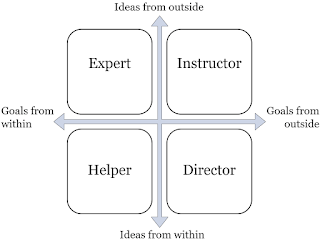
In 2008 I developed the 4 Progress-Focused Roles model (4PR model) together with my colleague Gwenda Schlundt Bodien (with whom I also, 4 years ago, co-developed the progress-focused approach as a whole). The model describes four different roles from which progress-focused professionals may work: helping, directing, training/advising, and instructing. It is a two-dimensional model which describes these four roles which apply in conversations.

Self-directed personality development

Image
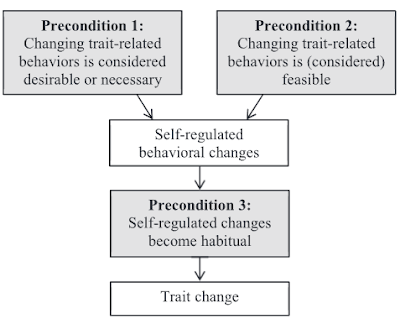
Personality traits are viewed as behavioral tendencies which are relatively stable over time and over a variety of situations. Both among lay people and psychologists there are many who think that changing one's personality substantially is hard or even impossible. This belief is primarily based on the observation that the personality of most people does not appear to change a lot during adult life. But a paper by Hennecke et al. (2014) suggests that self-directed personality change is possible. In the paper they explain why personality usually does not change much, why it actually can be done, and how it can be done.

Growth mindset intervention improves stress response of adolescents

Image
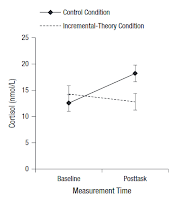
Adolescents are often exposed to negative social judgments. This can create stress when they feel they cannot meet the expectations of a social situation. Yeager et al. (2016) studied whether adolescents would be able to better deal with these challenges when they were taught that people have the potential to learn the required social characteristics. In other words, when they were taught a growth mindset with respect to personality.

Wisdom is associated with well-being

Image
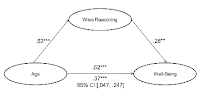
Are people with stronger cognitive abilities happier? Previous research into this question led to inconclusive results. Researchers Grossman et al. (2013) suspected that this was because this research primarily looked into the relation between intelligence and well-being and not to other qualities such as wisdom. That is why they did a study with 241 people in which they investigated the relationships between 5 variables: 1) intelligence, 2) wisdom, 3) personality, 4 age, and 5) well-being. Wisdom was measured through a structured interview method; the other variables were measured using validated tests and scales.

Everyday wisdom is not a stable personality trait

Image
Igor Grossman and Ethan Kross (2014) showed that people, by looking at their own problems from a distance (from a third person perspective), can come to wiser judgments ( read more about their studies ). A new study by Grossman et al. (2016) focuses on the question how stable or dynamic wisdom is in daily life. The researchers did a daily diary study into wise reasoning which lasted 9 months with 152 participants and which asked people to reflect on problems which that had had the previous day. They measured 3 facets of wisdom: intellectual humility, self-transcendence (being able to view your situation from a distance), and consideration of others’ perspectives/compromise.

Mindset-intervention before college narrows achievement gaps

Image
A new study by Yeager et al. (2016) tested the effects of preparatory lay theory interventions to reduce racial, ethnic, and socioeconomic achievement gaps when students enter college. Lay theory interventions are interventions aimed at helping students understand that challenges in the transition to college are common and improvable and, thus, that early struggles need not portend a permanent lack of belonging or potential. Often, these interventions are done when students are already at college. Preparatory lay theory interventions are done before students have entered college. As the study suggests they work. The picture on the right shows why. These interventions help people explain struggles and problems in a different and more constructive manner which helps them to respond more effectively to them and to be more successful.

Hate gays? Maybe You’re Gay

Image
Have you noticed the paradox that sometimes people who are vocal opponents of gay rights at some point turn out to be gay themselves? Did you hear that the person responsible for the mass shooting at a gay club earlier this week had been a regular visitor of that club and chatted with men via online dating services like Grindr? How to make sense of this paradox?

Meaning and motivation in work: what is the role of managers?

Image
In this video, Ed Deci, co-developer of the self-determination theory, explains that we, as parents, teachers, coaches and managers should not try to motivate people but instead can try to create the conditions within which people can motivate themselves. People are not like, so to speak, empty vessels in which we have to pour motivation.  People are naturally motivated to explore and try to understand their environment and to try to make useful contributions. If you still treat people like motivation-less creatures into which motivation has to be pumped you will inevitably create resistance because you disregard their already existing motivation and their ability to further motivate themselves.

How to defeat dangerous belief systems

Image
In this post I explained that there is, to some extent, a competition going on between the goals of our genes and our goals as an individual. As Keith Stanovich argues, building on Richard Dawkins' book The Selfish Gene , we humans have become aware of the fact that our genes' interests are not always in our own interests and that we can, at least to some extent, liberate ourselves from these genetic influences we do not serve us.

How to break the power of collective delusions

When is it sane to hold a specific belief? One way of thinking about this is that when a majority of people hold the same belief it is probably true and therefore it must be sane to hold the belief. But this approach is erroneous. It has be known for a long time that collective delusions exist. For example, Charles Mackay's 1841 book Extraordinary Popular Delusions and the Madness of Crowds documents national delusions, peculiar follies and philosophical delusions. Collective delusions have always existed and they still do and they may cause serious harm. So how is it possible they exist at all? And how may we break their power over us?

Review of The Big Picture (Sean Carrol, 2016)

Image
I learned about Sean Carroll, theoretical physicist at Caltech, through various interesting YouTube videos on topics such as the non-existence of an afterlife , theism versus naturalism , the arrow of time , the relation between the laws of nature and the meaning of life . Elaborating on that latter theme, Sean Carroll has written an extremely ambitious new book called The Big Picture, On the Origins of Life, Meaning, and The Universe itself in which he, as the title suggests, presents a view on everything trying to integrate what scientists have discovered about cosmology and particle science with a view on meaning of life and morality.

Deliberate practice is also important for creative achievement

Image
Scott Barry Kaufman wrote an article in which he asserted that deliberate practice may be important in achievement domains such as chess and playing a musical instrument but that it does not work as well for almost any creative domain. His argument is: deliberate practice works well for activities which rely on consistently replicable behaviors that must be repeated over and over again but this is not what creative performance relies on. In a response to Kaufman's article, The deliberate creative , Cal Newport refutes Kaufman's assertion convincingly.

Interview with Anders Ericsson

Image
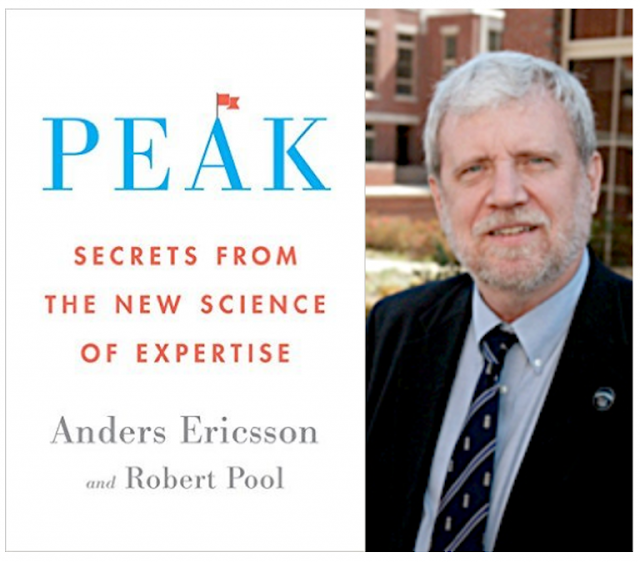
K. Anders Ericsson is a Swedish psychologist who is a professor at Florida State University. In the beginning of his career he worked with among other Nobel laureate Herbert Simon. He is recognized as the most prominent researcher in the area of expertise development. Together with his colleagues, he has done research into how experts in different areas have managed to reach the top of their fields. Uptil now he has mostly scientific publications. But now he and Robert Pool have published a popular book about expertise development: Secrets from the New Science of Expertise . Here is an interview with Ericsson about this new book. 

Epistemological interviewing

Image
Irrational beliefs can be harmful to ourselves and others. Therefore, being prepared to update our beliefs (making them more realistic/rational) can be wise. However, this is usually not easy because there can be multiple obstacles to do it. But if if we see the usefulness of letting go of irrational beliefs a few practical tips can help us make progress. Helping other people to get rid of irrational beliefs is another matter. We usually recognize other people's irrationality easier that our own irrationality (if we'd clearly see that our beliefs were irrational we would not hold on them in the first place). Seeing other people's irrationality can make us want to confront them about their irrationality. However, such confrontations seldom work.

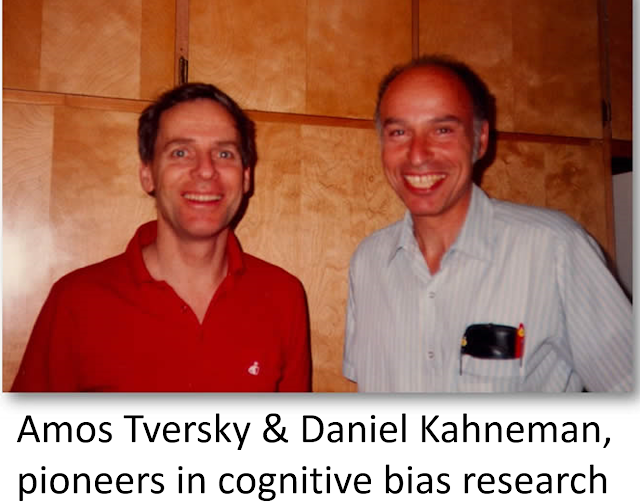
23 Cognitive biases, heuristics and effects

Image
One of the ways we can counter irrational beliefs is by informing ourselves about some well documented cognitive biases, heuristics and effects which all to some extent skew are perception of reality, usually without us being aware of it. I'll keep my explanations brief because it is quite easy to learn more about each of these biases, heuristics and effects by googling them.

3 Types of harm from irrational beliefs

I define irrational beliefs as beliefs which are incoherent or logically inconsistent and which are in conflict with what we know about reality (in conflict with available evidence, that is). Nobody is free from irrational beliefs. Our way of interpreting reality is not and never will be perfect. We are afflicted with systematic biases in how we perceive reality. Furthermore, through our upbringing and culture, we all inevitably have, without us being aware of it, adapted beliefs which are outdated. That we have irrational beliefs does not mean we must acquiesce in that fact. Critically reflecting on your own beliefs is a good thing. It enables you to develop your view on the world and to make it more realistic. For several reasons that can be hard. In this post I described four factors which impede the process of changing our of beliefs: (1) the confirmation bias, (2) self-fulfilling prophecies, (3) labeling oneself based on one's beliefs, and (4) social pressure. Then, in ...

Our rebellion against our genes

Image
In 1859 Charles Darwin published his book The Origin of species in which he described a mechanism for the process of evolution of species for the first time. At its core the idea of evolution boils down to: the unity of life (all life is connected), the diversity of life, and the match between organisms and their environment can be explained by descent with modification through natural selection ( Vermeij, 2015 ).

The Dunning-Kruger ramp

Image
The Dunning-Kruger effect is the phenomenon that people who are incompetent in a certain area often are not aware -and cannot be aware- of just how incompetent they are. A explanation of this counter intuitive effect is the following: when you know little about a subject you do not know how much knowledge you are lacking due to which you are likely to overestimate yourself.

Where I disagree with Steven Weinberg

Image
Writing down the title of this post feels awkward and even a bit scary. Who am I to disagree with Steven Weinberg ? He is a paragon of rationality and intellectual accomplishment. He's won a Nobel prize in physics, he coined the phrase 'standard model' and he recently wrote a wonderful book on the history of science ( read more ). So he has lots of authority on matters of science whereas I have little if any. Yet, in determining truth, authority alone is not a valid argument. So I will point out where I think he is wrong.

How To Study

Image
Guest post by Jamie Hale  The effort required to form strong memory is often intense for students. Students often spend hours trying to master new information. Of course, methods to enhance memory are important for everyone, not just students. For example, when a friend recommends a new shoe store we want to remember the name of of it, or when going to the grocery it is important to remember the items we need to pick up. What are some strategies that can be used to strengthen memory?

Trump's escalating rhetoric resembles the methods dictators use

Image
In this post from 2012 , I wrote that people may create fear in order to control other people. I explained that creating fear is an effective way of gaining people's attention, creating hyper-vigilance, suppressing their rationality, and legitimizing violence in order to fight the (supposed) threats and to enforce loyalty. People doing this set in motion a vicious cycle. In other words, a process of escalation seems inevitable. In order to keep their followers' fears sustained, and their rationality suppressed, they have to keep feeding them new information about the (supposed) threat. By creating more fear, they get more attention, suppress more people's rationality, legitimize greater violence, and acquire greater control. These are the methods dictators use.