Posts

Showing posts with the label autonomy

Autonomy is different from independence and freedom

Image
In the world of personal development and psychology, we often use terms such as autonomy, independence, and freedom interchangeably. Although these concepts may seem similar, they represent different aspects of the human experience and motivation. Below I explain why autonomy is different from independence and freedom, and why it is important to understand these differences.

Listening quality reduces loneliness through relatedness and autonomy

Image
Recently, Itzchakov et al. (2023) examined the influence of listening quality on feelings of loneliness, especially in people who have shared an experience of social rejection. The researchers expected that high-quality listening, defined as behavior that conveys attention, understanding, and positive intentions, would have several positive effects on the person telling about the painful experience.

How to talk so kids will listen & listen so kids will talk?

Image
As parents, we think few things are more important than that our children are doing well. Fortunately, through the way we raise them, we can have a significant impact on their mental health. In order to be able to use that influence properly, it is important to know what works well in parenting. Joussemet et al. (2018) are currently conducting research of which the results are not yet in. Their description of their research is interesting anyway because it provides insight into some key aspects of effective parenting.

Nourishing ARC basic needs during the Corona crisis

Image
Right now, the world is still in the grip of the Coronavirus. Many are diligently looking for ways to deal with this troubling and challenging situation. Countless professionals, for example in healthcare, work hard to keep society running as smoothly as possible. We are looking for ways to keep in touch with each other in groups, for example through online meeting tools. An enormous amount of creativity and helpfulness is released. There is a lot of advice on social media on how best to survive this difficult time. I would also like to make a small suggestion.

Basic psychological needs: overview and developments

Image
Basic Psychological Need Theory (BPNT) is one of the six mini-theories that make up Self-Determination Theory (SDT). In a new paper Maarten Vansteenkiste, Richard Ryan and Bart Soenens give an overview of the developments within the BPNT. Here I briefly summarize the article.

Where does meaning in life come from?

Image
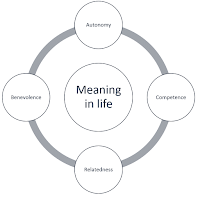
In earlier times the question of how to lead meaningful life was simply answered by referring to the bible (or another religious text, depending on when and where you were born). But for an increasing number of people religious dogma is no longer a satisfying answer to the question what a meaningful life means. Nowadays it has become a common wisdom that we should discover or create meaning in life ourselves. This raises two questions: how important is a sense of having meaning in life anyway, and -if it is important - how can we find or create it?

The Emerging Neuroscience of Intrinsic Motivation

Image
A new paper by Di Domenico & Ryan (2017) describes how a neuroscience of intrinsic motivation is emerging. Intrinsic motivation is the total of our spontaneous tendencies to be curious and interested, to seek challenges, and practice to develop our skills and knowledge even in the absence of separate rewards. Research within the framework of self-determination theory has shown that intrinsic motivation is a motivation which is present throughout the life span and which is associated with various positive effects such as learning, performing, creativity, and well-being. But intrinsic motivation is dependent on the perception of one's own competence and autonomy. If these two basic needs are thwarted, we tend to be less intrinsically motivated.

Three basic needs: always operative even when we don't realize it

Image
We use the word 'need' broadly in daily life. It can refer to anything we desire for or think we need or prefer, at any time. In psychology, in particular within self-determination theory (SDT), it has a much more specific meaning. SDT speaks of universal basic needs for autonomy, competence, and relatedness ( read more ). The word 'need' in SDT refers to something that is a requirement for good and healthy functioning.

Equality-Based Respect: Key to Social Progress

Image
The need for autonomy is a universal basic need of people. When it is satisfied we feel better and we function better in all kinds of ways ( view this ). Therefore it is wise to support other people's need for autonomy in all kinds of contexts. This can be done in several ways: by providing choice, by encouraging self-initiative and experimentation, by asking for and using their input in decisions, etc. A new study points at yet another way of supporting autonomy by respecting individuals as equals.

10 Questions to help you fulfill your basic needs

Image
Self-determination theory distinguishes three universal basic psychological needs, the need for autonomy, for competence, and for relatedness. The fulfillment of these needs is necessary for us to feel well and function well. The need for autonomy refers to the experience of being able to make your own choices and to stand behind what you are doing. The need for competence refers to the experience of being effective and capable of achieving desired outcomes. The need for relatedness refers to the experience of a mutual connection with and care for important people your life. Recent research by González-Cutre et al. (2016 ) indicates there may be a fourth basic need: the need for novelty, the need to keep on experiencing new things which deviate from your daily routine.

Activating a student

Image
I came across a beautiful example of activating a student in a progress-focused manner.  Tina teaches high school students in a special boarding school. During the brief period (usually several months) in which these students are at the boarding school they work independently on their subjects most of the time and whenever they need some help or explanation Tina and their colleagues provide it to them. Of course, every now and then the students also have to take tests. Tina frequently uses progress-focused principles and techniques such as growth mindset interventions and autonomy supportive interventions. Every day, she writes brief observation/reflection diary entries, both for her own purpose and to inform her colleagues about what happened on that day. I have read and remembered one of the recent entries in that diary. I went something like this.

Working in solitude on very ambitious goals

Image
New research suggests how people may work in solitude on very ambitious goals and feel good about it.  Some famous artists and scientists from the past must have set extraordinary ambitious goals for themselves and must have worked for extremely long periods of time in solitude on their work and discoveries. For example, it is known that Isaac Newton, generally viewed as one of the greatest scientific geniuses of all time, who was highly productive as well, spend many years working in relative solitude. I have sometimes wondered how such people have managed to accomplish such things and to what extent they experienced gratification about their life style. I came across two articles by Thuy-vy Nguyen which give a clue about how some people are able to lead and bear such lives.

How do you get goals that work?

Image
Self concordant goals, goals that fit with your interests and values have many advantages. How do you get them? It is not only important that people set goals but also what types of goals they set. Within Self-Determination Theory the term self concordant goals has been introduced. Self concordant goals are goals which are consistent with the developing interests and values of the individual. When goals are self concordant people fully endorse these goals. They are autonomously motivated to pursue them.

Parenting and autonomy and relatedness

Image
Parenting style affects how autonomous and related children will feel. Self-determination theory has shown that individuals, throughout their lives, have needs for autonomy, competence and relatedness. Simply put, the more their needs are fulfilled, the better individuals feel and function. Past research has shown that the degree to which parent support the fulfillment of these needs the more adapted and well-functioning their children will tend to become ( read more ). When parents use an authoritative and controlling parenting style, their children's development is likely to be hampered to some degree. Examples of such a controlling parenting style are: use of controlling language, emphasis on punishment ànd reward, use of threats, arousing guild and anxietym and using contingent parental regard and affection.

Raising kids to become autonomous individuals

Image
The importance of autonomous functioning As research into self-determination theory has shown there is a strong connection between people’s autonomous functioning and their wellness, their open, engaged and healthy functioning. When people feel autonomous they feel they can make their own choices and follow their own preferences. This does not mean they will be selfish, over individualistic, or self-sufficient. In fact, under good enough conditions, people will actively attempt to internalize and integrate the norms, rules and values of their environment, in other words make them their own. This process of internalizing and integrating external norms, rules and values will happen best 1) when they are transmitted in an autonomy supportive rather than a controlling way, and 2) when these norms, rules and values are congruent with the basic psychological needs for autonomy, competence, and relatedness (Ryan & Deci, 2011).


The tilt intervention for working with involuntary clients

Image
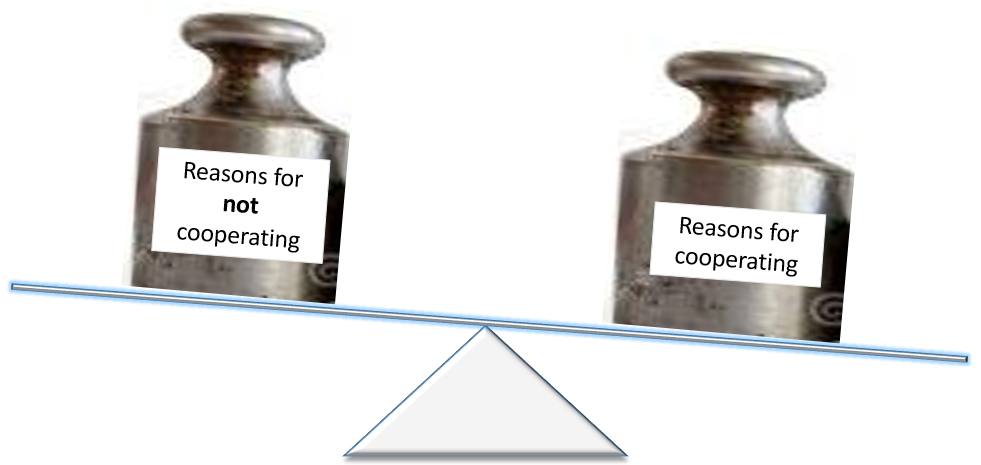
In coaching, supporting the autonomy of clients is extra important with involuntary clients. Involuntary clients are clients who's own idea it wasn't to go to a coach but who were sent by someone else. Although these clients may at first be reserved or uncooperative it is usually possible to reach a good cooperation with them rather fast. The key to doing that is to recognize their perspective and to acknowledge and accentuate their autonomy.

Autonomy support at work

Image
Self-determination theory (SDT) is one of the most powerful frameworks to understand how human flourishing can develop. Here is a very brief recap of what it is*. SDT assumes two things about human beings: 1) that they are naturally active and growth-oriented, and 2) that they have a tendency toward psychological integration . This second process means that, as people encounter new experiences, they are challenged to integrate them with existing aspects of themselves. This process of integration leads individuals to develop increasingly complex self-structures in which values and regulatory processes from outside are internalized.

What is meaningful work?

Image
As Teresa Amabile and Steven Kramer have shown, making progress in work that is meaningful is one of the most motivating, if not the most motivating, things in work. Even small progress may have a big positive impact on one's inner work life (this is the authors' term for perception, emotions and motivations in one's work). 'Meaningful progress', of course, consists of two parts: the meaningful part and the progress part. I have focused a lot on the progress element in many previous posts. I'd now like to focus on the meaningful part.

Combining practice based learning and theory based learning

Image
As mentioned before on this site, I am rather reluctant about the usefulness of a giving advice - especially unasked-for advice. In general my assumption is that self-found internal solutions , solutions which are based on people's own experience and which they can apply themselves without help or training by others, are the most motivating way forward in many situations. By the way, from this, it does not follow that we can't help other people. We can actually help people identify their own internal solutions. But the way to do this is not to offer them judgments and advices. Instead, through a process of asking carefully chosen questions and interventions people can, in many cases be helped to find their own solutions to problems ( here is an example of how such a helping strategy may be designed).

Promoting freedom and influence around the world

Image
Abolishing dictatorships That several peoples in several North African and Middle Eastern countries are revolting against their dictators seems a good thing to me. I think all people desire for freedom and influence and all countries deserve and are potentially capable of democratic self-rule. I am convinced that the liberation of these countries will not only free the peoples of those countries but also make peace in the region and in the world at large more likely. Why? Because I think that the tendency towards war usually (perhaps always) begins with tyranny; the threat of war seems like the fuel on which tyranny runs. Whenever non-democratic leaders face opposition from the people they attempt to neutralize this by creating fear and control. The reliable way to do this is to create the threat of war with self-created external enemies. This way they legitimatize the enforcement of loyalty. This may explain why dictators often routinely use a language of hate and violence up to ...