Posts

Showing posts with the label Progress

Discomfort as a sign of personal growth

Image
The process of personal growth is often accompanied by the experience of discomfort. This is because it usually means stepping outside of our comfort zone. For example, when we learn a new skill, it can feel uncomfortable because it is unfamiliar and we may make mistakes. So discomfort is often a natural part of learning and growing. We can tend to see it as a necessary evil that comes with learning. It can also lead us to learn and grow but prefer to get out of the way.


Blockchain and crypto: The challenges and opportunities for progress

Image
Progress can occur in various aspects of life, and technology has the potential to drive significant changes, ideally for the better. One technology that has gained attention recently is blockchain. In a previous article , I explored the potential of blockchain as a powerful source of progress.  Despite the challenges faced by centralized financial institutions and some major centralized organizations in the cryptocurrency world, I maintain a positive outlook on the potential of blockchain and crypto to make progress. Even though I am not an expert in this domain and acknowledge its complexity, I am still fascinated by it. Consequently, it may be valuable to re-examine the fundamentals of blockchain and cryptocurrency and explore their potential for driving progress.

The Precipice: Existential Risk and the Future of Humanity

Image
A new book has come out progress on the largest imaginable time scale. It's called The Precipice and it was written by Oxford-based Australian moral philosopher Toby Ord . The book states that we, as humanity, may only be at the beginning of our development. Humanity has existed for 200,000 years and there could be millions of future human generations. In the time we have had as humanity so far, we have made significant progress in improving the human condition, particularly in the last few hundred years. As humanity, we have collaborated with each other over time and distance.

Upward spiral between autonomy support and autonomous motivation

Image
Research in self-determination theory has shown that individuals who are autonomously motivated make more progress and feel better. Research has also shown that autonomy support by parents, teachers or supervisors increases the autonomous motivation of children, students and employees respectively. That sounds logical and simple. But there is a little more to the interplay between these variables. New research by Levine et al. (2020) shows that an upward spiral occurs between autonomous motivation and autonomy support.

The problem as the beginning of progress

Image
In the progress-focused approach , a problem is often viewed as the potential beginning of progress. Both individual conversations and team sessions often start with discussing problems, things that are not going well or things that have gone wrong. Having problems is, of course, unpleasant and can lead to dissatisfaction, frustration or even a feeling of powerlessness.

Social Progress Index 2020: Is the world making (enough) progress?

Image
The Social Progress Index (SPI) of 2020 has been published today. The SPI uses non-economic indicators to chart how well countries are doing. Read below how it works in the 163 countries described in the SPI. Overall, is the world continuing to make progress? How is your own doing? Are there certain things that clearly need improvement? Which countries are progressing the fastest? Which countries are actually declining? How is the United States doing in the era of Donald Trump?

Do you see both achieved progress and further needed progress?

Image
To which degree and how we focus our attention on progress has important consequences for how feel and behave. There are several types of mistakes we can make in how pay attention to progress. Below I describe three mostly ineffective ways of looking at progress and one effective way. For this purpose I use a 2x2 model which is structured around two questions. The first question is: do you have a clear view on achieved progress? The second question is: do you have a view on what further progress needs to be made? These two questions are equally important. Perceiving achieved progress makes us more optimistic and helps us understand what has worked so far. Perceiving which further progress needs to be made gives us a perspective and something which we can usefully focus our energy on. The 2x2 model shows four quadrants each of which represents a way of focusing on progress.

The vital role of frustration in deliberate practice

Image
I received many responses to my article How we can keep on breaking through performance ceilings . Most were positive, some where constructively critical. Most were about the claim that stretching one's abilities comes with a certain discomfort and frustration. One person asked whether this frustration or discomfort is really necessary. Another person asked whether this frustration does not contradict the progress principle which says that experiencing meaningful progress is very motivational ("how can experiencing frustration ever be motivational?").

Countermeasures against the negativity effect

Image
The negativity bias is the phenomenon that we notice negative events more easily, that we are affected more strongly by them, and that we remember them more easily. Although not every individual and every age group is equally vulnerable to the negativity bias it is quite common. For example, Amabile & Kramer (2011) , in their study on inner work life, found that the impact of negative events on a work day was two to three times stronger than that of positive work day events.

Progress: Ten Reasons to Look Forward to the Future

Image
The Swede Johan Norberg has written a book in which he describes how the world has made progress in many areas. The book, titled Progress: Ten Reasons to Look Forward to the Future , has ten chapters in which the following topics are treated: food, sanitation, life expectancy, poverty, violence, the environment, literacy, freedom, equality, and children's rights and perspectives. In his treatment of these topics Norberg uses vivid examples and a lot of objective data. Even if you have read some things about the great progress in the world, you will probably still come across some informative new material in this book. The book is interesting although I have a point of criticism.

When is positive feedback more motivational and when negative feedback?

Image
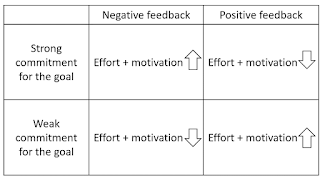
Constructive feedback, both negative and positive, can play an important role in goal achievement. Previous research by Koo and Fishbach (2008) demonstrated that feedback can signal two kinds of messages. The first type of message is about commitment: it can say something about whether your goals are valuable and whether you have a good change of achieving them. Individuals which are not strongly committed to a certain goal can become more motivated after receiving positive feedback (and less after receiving negative feedback). The second message is about progress: feedback can say something about whether you have put in enough effort and whether you have achieved enough progress. Strongly committed individuals tend to get more motivated by negative feedback and less motivated by positive feedback (see the figure on the right). By the way, with negative feedback I do not mean personal criticism or blame but constructive information about what is not going well yet and what could b...

5 steps to harness the progress principle

Image
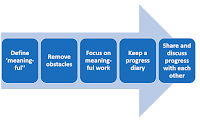
Coert Visser, September 6, 2013 In their large-scale study, Teresa Amabile and Steven Kramer have discovered that making progress in meaningful work is a main contributor to a positive work life and to good performance (Read more about this study, here ). Here are a few practical suggestions to harness the power of meaningful progress.

Discuss progress with each other

Image
Coert Visser, September 12, 2013 By focusing on progress in meaningful work, your work experience and your performance are stimulated . It is useful to make explicit what progress you have achieved, for example by keeping a progress diary . If you don’t make progress explicit it may well be that you are not aware of the progress you are actually making. This is because progress can remain largely invisible if you don’t consciously focus on it. The reason for this is that we usually focus our conscious attention mainly on what has gone wrong and on what we still have to do. Progress which you have already made is thus easily overlooked.

Remove obstacles

Image
Coert Visser, September 9, 2013 Making progress in meaningful work is one of the most motivating factors for employees. Therefore, it is important to talk about and to describe desired and achieved progress, frequently. But did you know that negative occurrences such as setbacks and failures can have a 2 to 3 times stronger (negative) effect on motivation than positive factors? This was shown in a study by Amabile and Kramer .

Define ‘meaningful’

Image
Coert Visser, September 7, 2013 In 5 steps to harness the progress principle I mentioned the research finding that progress in meaningful work is extremely motivating. In other words, the more you think that your work contributes to what is valuable to you, the more motivating it will be for you to achieve progress in this work. To speak of meaningful work, means to go beyond a simple task or results focus. To do meaningful work means that, as an employee, you have the feeling that completing the task or achieving the results is linked to an underlying purpose that is valuable to you. Here is an example.

Saving capitalism (Robert Reich)

Image
Some time ago I wrote about economist Richard Wolff's book Democracy at work. A cure for capitalism in which he argued that capitalism is inherently threatening to democracy and that a fundamental change is needed in the direction of Worker Self-Directed Enterprises (WSDEs) which would be an alternative to capitalism ( read my explanation of this argument here ). While I found the book interesting, I wasn't convinced that capitalism should be replaced. Now, there is a book by another economist, also one who is very critical about current day capitalism and concerned for the protection of the democracy, Robert Reich . The book is called Saving Capitalism: For the Many, Not the Few and it argues not for the replacement of capitalism but for its rescue.

The importance of talking about problems and the past

Image
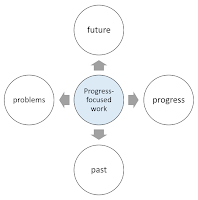
Sometimes people make the following two assertions about progress-focused work: (1) progress-focused work is not focused on problems but on progress, and (2) progress-focused work is not focused on the past but on the future. These assertions sound enthusiastic and I'd rather not be a killjoy but I find it important to contradict them. Neither talking about the past, nor talking about problems is a taboo in progress-focused work. Indeed, both are important elements in virtually every progress-focused conversation. I'll explain below.

Letting go of irrational beliefs

Image
Being able to change your beliefs is necessary for keeping on playing a positive role in the world. Not being able to think critically about your own beliefs and to change them when they are not true eventually will keep you from playing a constructive role. An ultimate example of the inability to change one's views can be found in religious fanatics who create death and destruction while believing they are doing something good. Letting go of beliefs can be important but also hard.

Believing in progress is not the same as believing in perfection

Image
Recently, a debate took place between Steven Pinker and Matt Ridley on the one site and Malcolm Gladwell and Alain de Botton on the other side. The debate was about the motion 'human kind's best days lie ahead'. Pinker and Ridley defended the motion, Gladwell and de Botton argued against it. You can watch the debate here .

4 Factors which impede change of beliefs

Image
Because beliefs have such great influence in our lives, it is important to be able to evaluate our beliefs properly and to keep developing them. Beliefs are malleable. We can find out that a belief we used to have is untrue and restricts us in our life. But changing our beliefs is not always easy. That is because, as people, we have certain obstacles which may impede changing our beliefs. I want to mention four of those obstacles.