Posts

Rationality taxonomy

Image
When I interviewed  Keith Stanovich  in 2009, he explained that intelligence tests are not good measures of good thinking because they do not assess the extent of rational thought. His research had shown that intelligence test scores, at best, only mildly predicted rational thinking an that some rational thinkin skills are totally dissociated from intelligence. Later in the same interview he said he had started to sketch out a framework for the assessment of rational thought. As a recent publication by Toplak, West, & Stanovich (2013) shows, there is now such a framework:

r>g

Image
Thomas Piketty, author of Capital in the Twenty-First Century Until 2010, I did not know much about the consequences of economic inequality. Then I came across the book The Spirit Level in which the authors Richard Wilkinson and Kate Pickett presented their research results which showed that high levels of inequality in societies is harmful for everyone within them. Their research showed that (1) the more developed a country is, the less important further economic growth is for certain objectively measurable outcomes, like life expectancy ( see graph ), (2) in a study of 23 of the richest countries there was a strong relationship between health and social problems and the level of income inequality ( see graph ), (3) in a study of the 50 American States this same relationship was found ( see graph ).

Progress-Focused Directing

Image
Progress-focused directing is a technique which we developed around 2005. It can sometimes be quite useful for managers, teachers, and parents. It can be used in situations in which individuals have to conform to certain rules or have to accomplish goals. The approach is intended to help individuals understand what the rule or goal is and why it is important and to activate them to start finding their own ways to make progress in the desired direction. When do you use it? This type of providing direction fulfills two kinds of functions: (1) clarifying expectations, (2) setting limits. Clarifying expectations is an important part of managing, teaching and raising kids. Anyone who is part of a social system (a society, an organization, a school, a family) has to adapt to and to some degree conform to certain expectations in order to function and develop well and to make a valuable contribution.

The tilt intervention for working with involuntary clients

Image
In coaching, supporting the autonomy of clients is extra important with involuntary clients. Involuntary clients are clients who's own idea it wasn't to go to a coach but who were sent by someone else. Although these clients may at first be reserved or uncooperative it is usually possible to reach a good cooperation with them rather fast. The key to doing that is to recognize their perspective and to acknowledge and accentuate their autonomy.

Interests as drivers of competence development

Image
Coert Visser (2014) Competence development is important for individuals and organizations. This article outlines the advantages of interest-focused development which is to structurally engage yourself with and train yourself in what interests you, both in the short and the long term. Interest-focused development An important motivation of people is what psychologists call competence motivation (Elliott & Dweck, 2005). Competence motivation is the tendency of people to make efforts to retain their level of competence and to develop it further. People from all cultures and of all ages have this motivation. The extent to which people feel competent contributes to their well-being and their functioning. Competence development will not come about automatically; it requires an investment. For anyone who wants to become more competent, the question is therefore important how that investment can be made most wisely.

Autonomy support at work

Image
Self-determination theory (SDT) is one of the most powerful frameworks to understand how human flourishing can develop. Here is a very brief recap of what it is*. SDT assumes two things about human beings: 1) that they are naturally active and growth-oriented, and 2) that they have a tendency toward psychological integration . This second process means that, as people encounter new experiences, they are challenged to integrate them with existing aspects of themselves. This process of integration leads individuals to develop increasingly complex self-structures in which values and regulatory processes from outside are internalized.

Using social network incentives to stimulate engagement, trust and results

Image
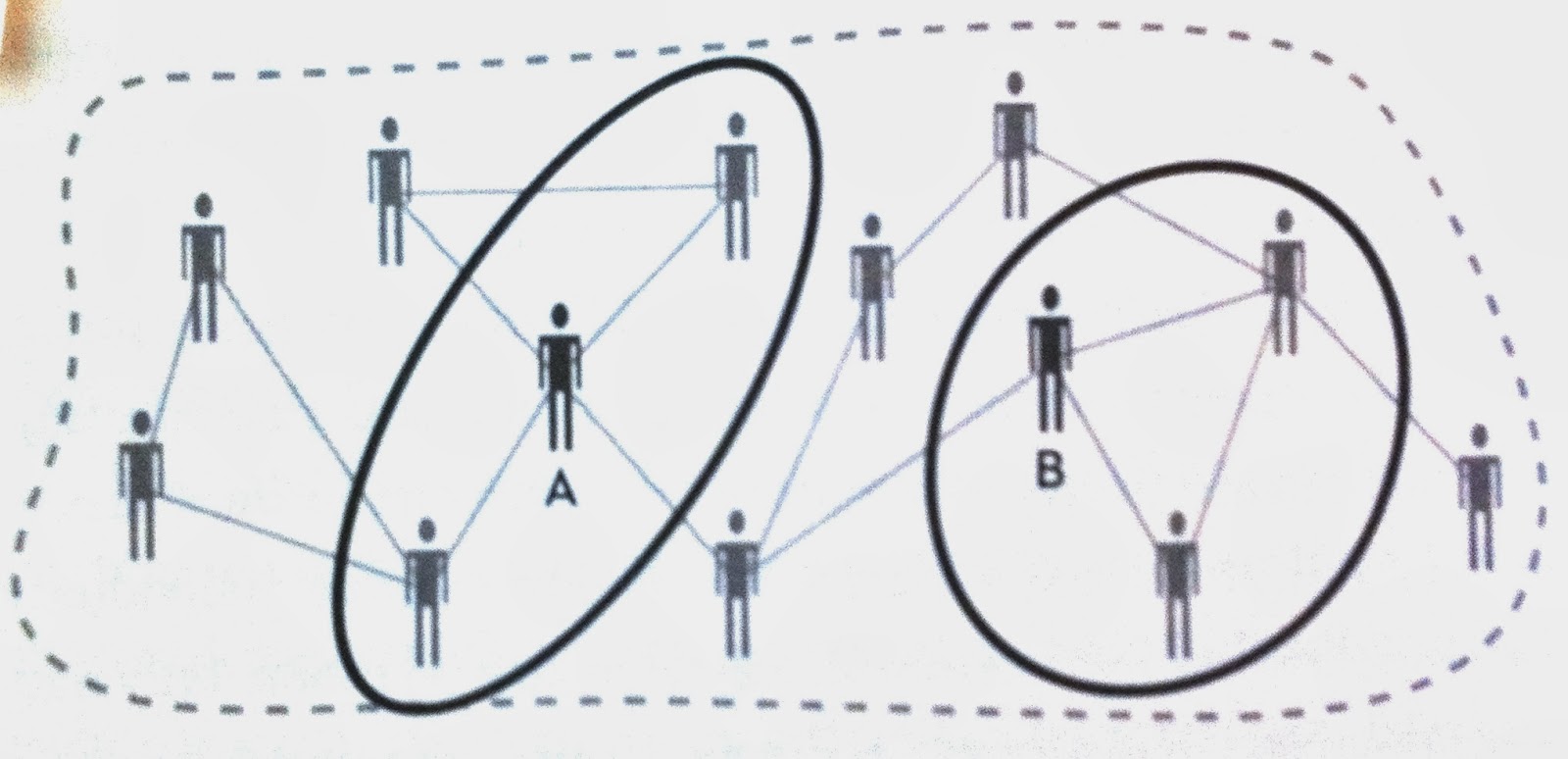
In this article I mentioned Alex Pentland's book Social Physics . One of the points frequently made in the book is that engagement , direct strong, positive interactions between people, within work groups is very important. By repeatedly interacting in cooperative manners, trust grows between team members and common beliefs, habits and norms emerge.

Are progress-focused skills just conversational tricks?

Image
In a recent training group I had been teaching participants about several progress-focused techniques such as the NOAM 7 steps  approach , the progress-focused circle technique , the positive no technique , and progress-focused directing (which is a way of making your expectations clear in a motivated and constructive manner). On the second day of the training, one of the participants made a remark which was something like this: "First of all, I really find all of this interesting and useful but I am wondering about something. If both we employees and managers learn progress-focused skills aren't both parties just becoming better at conversational trickery? First my manager will try to make a clever formulation to try to get me to do something and then I will counter that will some clever formulation of the positive no technique. It feels just like we are just applying tricks? I just don't think we will still be able to be honest and spontaneous!"

It can also be useful to look at what is outside of the outer circle

Image
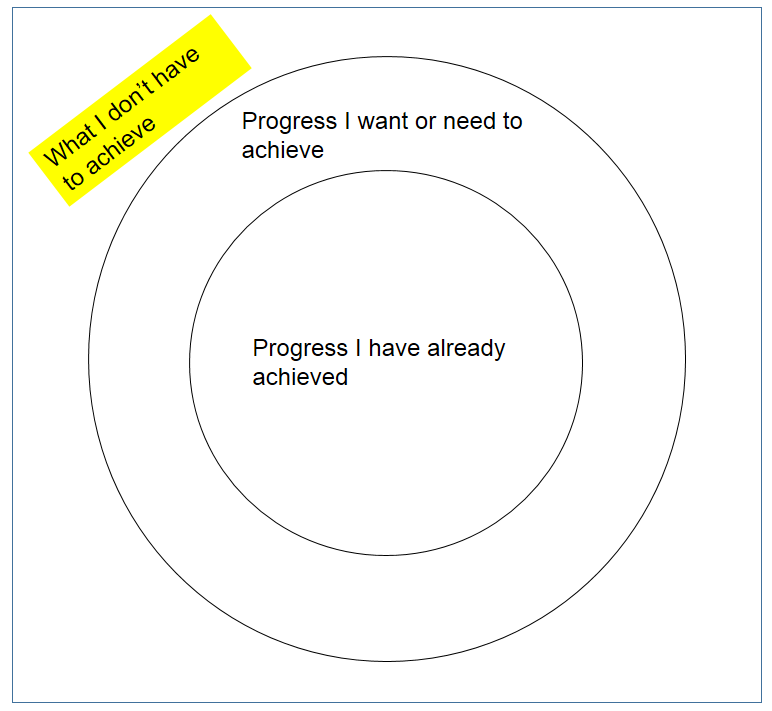
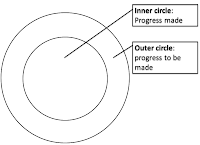
The progress-focused circle technique is getting more well-known and popular. It works like this: the coach draws two circles on a piece of paper or on a flip-over sheet, an inner circle and an outer circle. On small post-it notes clients write down what progress they have already achieved and then they hang them in the inner circle. Next, clients write on post-it notes what progress they further need and/or want to achieve and they hang these in the outer circle. Finally, clients choose which note(s) they first want to be able to move from the outer circle to the inner circle and how they will try to accomplish this. On the first day of a training I gave to a group of teachers I explained the circle technique and invited them to experiment a bit with it. I also gave an example of how I had once used the circle technique with a client of mine. What was interesting in that situation was that my client had not only hanged post-it notes in the inner and outer circle but also outside ...

How intelligent groups discover and learn from new ideas

Image
In his new book Social Physics , MIT data scientist Alex Pentland introduces the discipline of social physics, a big data approach to social science. The discipline focuses mainly on how ideas flow through groups and communities and how social learning takes place to enable productivity and creativity. The book describes much large scale research and many core concepts of social physics and it introduces ideas on how groups, organizations, cities, and societies can be made more effective.

What is meaningful work?

Image
As Teresa Amabile and Steven Kramer have shown, making progress in work that is meaningful is one of the most motivating, if not the most motivating, things in work. Even small progress may have a big positive impact on one's inner work life (this is the authors' term for perception, emotions and motivations in one's work). 'Meaningful progress', of course, consists of two parts: the meaningful part and the progress part. I have focused a lot on the progress element in many previous posts. I'd now like to focus on the meaningful part.

How progress can make itself invisible

Image
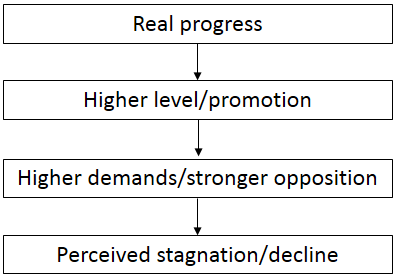
The feeling of making progress in something which is important to you is very motivating. But sometimes you make progress without being aware of it and thus you miss this motivating effect needlessly. In this article I explained some reasons why achieved progress can sometimes be hard to notice. One reason I mentioned is sensory adaptation. This means that we get used to the progress we have made and because of this we stop perceiving it. A second reason I mentioned is that we may interpret progress negatively. An example of this is that we may view the availability of technological resources not as advantages but as perils or problems. A third reason why we may not notice progress is that we may, sometimes unconsciously, concurrently raise the bar for ourselves. When this happens, not only our competence level has increased but also the level we aim for. Because of this, the distance between our current level and our goal remains the same (or even increases).

P-Curve Analyses: Finding out which Social Priming Effects are Likely to be True

Image
Professors are Not Elderly: Evaluating the Evidential Value of Two Social Priming Effects Through P-Curve Analyses By Daniel Lakens Abstract : It is possible that the number of false positives in the literature is much greater than is desirable due to a combination of low statistical power , publication bias , and flexibility when analyzing data. Recently, some researchers have argued t he replicability crisis social priming research is greatly exaggerated ( Dijksterhuis, 2014 ; Stroebe & Strack, 2014). To quantify the extent to which researcher degrees of freedom are a real problem, I present two p-curve analyses that examine the evidential value of research lines on professor priming and elderly priming. The results indicate studies examining elderly priming are p-hacked , while studies examining professor priming contain evidential value. I believe a polarized discussion about whether social priming is true or not, whether direct replications or conceptual replicat...

Adding constraints in order to improve performance

I am often intrigued by the complexity and paradoxes in optimal human functioning. One thing which interests me in particular is that our performance may sometimes be improved by deliberately adding constraints to the circumstances in which we have to perform. I came across nice example when I was watching Back and Forth about the rockband Foo Fighters. Just before starting to record the 2011 album Wasting Light , Foo Fighters front man Dave Grohl decided that instead recording the album digitally they would record it on tape. This implied that the recording process would be harder and less flexible. While digitally recorded music can be easily manipulated and corrected, analogously recorded music can't be. Grohl realized that the easiness of digital recording might make musicians a bit lazy and easy. After all, any mistake could be relatively easily corrected. But analogous recording would require the band members to be really sharp and play really well. While we can't know ...

In praise of high-level cognitive control when performing complex tasks

Image
In Going from Good to Great with Complex Tasks , Ozgun Atasoy explains that the belief that consciously thinking about what we are doing, when performing complex tasks, by definition harms our performance, is wrong. It is true that some type of conscious thinking can harm our functioning. For example, when we are typing on a keyboard, we run largely on auto-pilot. If we would try to consciously control the typing of each separate letter, this would slow us down a great deal and probably cause us to make many mistakes.

Advantages of interest-focused development

Image
Soon, I will post an article in which I make a plea for interest-focused development. In that article I will explain what I mean with interest-focused development and what its advantages are for individuals and organizations. Here, I will give a preview of that article by mentioning the direct advantages of interest-focused development. When we are doing something which interests us, in other words, which we enjoy and find meaningful, we enter a psychological state of attentive engagement and we experience positive emotions. In this state we think more clearly, we comprehend things deeper and more easily and we remember better (Murphy Paul, 2013) due to which we learn more efficiently and better.

Anders Ericsson responds to criticisms

Image
Why expert performance is special and cannot be extrapolated from studies of performance in the general population: A response to criticisms K. Anders Ericsson Abstract : Many misunderstandings about the expert-performance approach can be attributed to its unique methodology and theoretical concepts. This approach was established with case studies of the acquisition of expert memory with detailed experimental analysis of the mediating mechanisms. In contrast the traditional individual difference approach starts with the assumption of underlying general latent factors of cognitive ability and personality that correlate with performance across levels of acquired skill. My review rejects the assumption that data on large samples of beginners can be extrapolated to samples of elite and expert performers. Once we can agree on the criteria for reproducible objective expert performance and acceptable methodologies for collecting valid data, I believe that scientists will recognize the n...

Gardiner, Bach, and the desire to detect weaknesses in high-achievers

Image
Johann Sebastian Bach was one of the greatest classical composers of all time (for example, read  this  and this ). Many people have pointed out that his oeuvre is both enormously large and enormously varied and that it hardly has any weak spots. Many people even rave about Bach that his work is indeed flawless and use hyperboles like that Bach's music was divinely inspired, that Bach was God's pupil or even, perhaps only half-jokingly, that Bach IS God. John Eliot Gardiner , the famous conductor, has written a new book called Bach: Music in the Castle of Heaven . In this video , he says that biographers of Bach make a logical error by thinking that because Bach made such great music he must have also been a great man. Then, Gardiner goes on to say that Bach certainly wasn't a paragon of virtue and that he actually was a deeply flawed character. He says this because in Bach's life, according to Gardiner, there is "almost a repetitive pattern of antagonistic b...

Utilizing the principle of reciprocity seeking in progress-focused coaching and mediation

Image
Human nature not only has a competitive side to it, which expresses itself through tendencies such as resource striving and status seeking ; it also has an equally important, if not more important, cooperative side which expresses itself through tendencies such as fairness and reciprocity seeking and group identity seeking (for more about this read The dual human nature: competitive and cooperative forces ). Here, I want to focus on one of those cooperative tendencies, namely  reciprocity seeking . The principle of reciprocity seeking, which has a strong impact how we behave in social interactions, implies that if someone else does us some kind of favor we want to give a favor in return to that person. Negative reciprocity, by the way, means that if we feel that someone treats us badly, we want to treat them badly in return. In other words, we tend to want to give back what we feel we get.

Balancing a progress-focus and a commitment-focus

Image
There is much evidence that the world, on the whole, is getting better in many ways (see for instance work by Matt Ridley , Steven Pinker , and Hans Rosling ). In accordance with this view is a new article by  Zack Beauchamp  on Thinkprogress called  5 Reasons why 2013 Was The Best Year In Human History . He presents the following 5 reasons:

Careful with that coping question

Image
One type of question which progress-focused coaches ask is the coping question. This question is mainly used when coachees experience their circumstances as really hard and more or less hopeless. The basic for of this type of question is: How do (/did) you manage to go on under such difficult circumstances? But there are many different ways in which the question can be asked, such as:

The benefits of social cognition vs the benefits of task-focused processing

Image
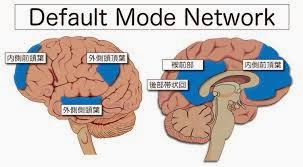
In Social: why our brains are wired to connect  (also read this post ), Matt Lieberman explains that, within our brains there are two quite distinct neural systems for respectively social and non-social thinking. These two systems appear to be antagonistic in the sense that when one of the two is very active, the other is largely inactive. In addition to this he explains that whenever a person is focused on a specific task the non-social system is turned on and as soon as the person stops focusing on the task, his or her social system will turn on. Because this neural system becomes active as soon as one finishes a specific task, it is called the default nework. It seems that when we are not focusing on a specific task we are not doing nothing. We are engaged in social cognition, in other words, thinking about other people and our relationships with them. Lieberman writes:

The key to creating new jobs: empowering innovations

Image
My view is that prolonged growth of inequality in developed economies is likely to be detrimental for human well-being (here are some references: 1 , 2 , 3 , 4 ). People on the political right often defend this inequality by claiming that the super rich must be allowed to stay super rich because they are the motors behind job growth. In this video , Clayton Christensen explains that how investments are made determines how economies develop. Essentially, investments can be targeted at three types of innovations: 1) empowering innovations which transform products from complex and unaffordable for the mass to simple and affordable, thereby expanding markets and creating jobs, 2) sustaining innovations , which make good products better, and which do not create many new products because they do not make markets larger, 3) efficiency innovations , which is making the same products at lower prices and which destroy jobs and free capital.

Dealing with the paradox of confident ignorance

Image
Charles Darwin once said: "Ignorance more frequently begets confidence than does knowledge." This sounds like a strange idea. Is it true that confidence sometimes signals ignorance? Is it true that people who are very confident about their opinions may actually be more ignorant than people who are less confident? If it is true, it might lead to a paradoxical prescription: if you feel very confident you are right about a topic you may not know enough about it. Is there evidence that confidence and ignorance may go hand in hand? Yes, a new study by Philip Fernbach et al. does provide some evidence: Political Extremism Is Supported by an Illusion of Understanding Philip M. Fernbach, Todd Rogers, Craig R. Fox, & Steven A. Sloman  Abstract : People often hold extreme political attitudes about complex policies. We hypothesized that people typically know less about such policies than they think they do (the illusion of explanatory depth) and that polarized attitudes are en...

Self-handicapping

Image
Readers of this blog will probably know that believing that human abilities and traits cannot be developed (this type of belief is called a fixed mindset ) has several disadvantages. One of those disadvantages is a fear of challenges and doing things that are hard. When you do something which is challenging you may make mistakes and fail and this could be interpreted as a lack of natural ability.