Posts

Showing posts with the label progress-focused

Asking for meaningful progress in job interviews

Image
Last week I met Dick Wever in a session on progress-focused working. He is a team leader at an educational institution, and he said he recently interviewed applicants for his school. He was not completely satisfied with the approach to the job interviews as they were conducted at school. That is why he tried out a new, progress-focused question in the interviews: the question of what meaningful progress the applicant had recently made. I didn't have much time to ask more about his experiences, but I found it so interesting that I kept thinking about it.


From authoritarian to progress-focused leadership

Image
This week, someone wrote the following: "‘You should just do what I say even if you disagree with it’ is really no longer acceptable." I agree with her. Managers who speak like this exhibit an authoritarian attitude that says, "You must do what I say, and I don't care about your opinion." Such an approach to management undermines the relationship between the manager and employee and the quality of the employee’s motivation.” Let’s move from authoritarian to progress-focused leadership.

The PFP-approach Progress-focused Future-projection Questions

Image
The PFP-approach is a powerful progress-focused tool. PFP stands for Progress-focused Future-projection Questions. This methodology uses a series of five strategically chosen questions that help individuals or teams visualize their future goals and identify the necessary steps to achieve these goals. The power of PFP lies in its simplicity and effectiveness, making it a valuable tool in team and organizational development.

The CPW 7 steps approach for coaches

Image
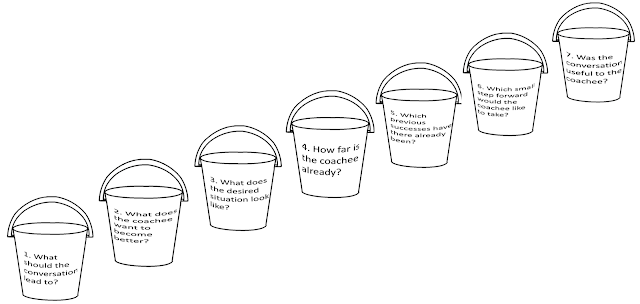
The CPW 7 steps approach (Visser & Schlundt Bodien, 2005; 2013 ) is a progress-focused interview structure that is used by many coaches. Both for beginning and experienced coaches this structure is a useful tool to guide their conversations with clients.  Not to be used rigidly  These steps can be used in individual coaching, in sessions with groups, and even in self-coaching. The sequence of questions is usually perceived by clients as logical and helpful. But the structure is not restrictive or rigid. In other words, it is not strictly required to always follow the structure. If you have little time, you can decide to use only a few of its steps. And if clients, by what they say to you, use a different sequence then it is quite alright to follow their sequence. The structure allows clients to bring forward anything they like. At the same time, it gives a useful direction to their responses. Through the questions, clients are led from where they want progress to how they ...

Checklist progress-focused organizational change

Image
Progress-focused principles and techniques are not only useful in individual conversations and team facilitation, but also in guiding organizational change. Here are some progress-focused principles that you as a manager can use in organizational change.

A Brief Introduction to the Progress-Focused Approach

Image
A Brief Introduction to the Progress-Focused Approach – A Guide for Managers, Coaches, Teachers, and Students  Coert Visser (2020)  This book introduces the progress-focused approach. This approach is a set of principles and techniques which help individuals and teams make achieved and desired meaningful progress visible and to get ideas about next steps forward. The progress-focused approach, originally inspired by some practical techniques from solution-focused brief therapy, now heavily relies on findings from scientific psychology. It is used by many coaches, trainers, managers, teachers and employees. 

Countermeasures against the negativity effect

Image
The negativity bias is the phenomenon that we notice negative events more easily, that we are affected more strongly by them, and that we remember them more easily. Although not every individual and every age group is equally vulnerable to the negativity bias it is quite common. For example, Amabile & Kramer (2011) , in their study on inner work life, found that the impact of negative events on a work day was two to three times stronger than that of positive work day events.

Coaching as the filling of 7 buckets

Image
Many progress-focused coaches are enthusiastic about our 7 steps approach . This approach reflects a conversation structure which often works quite well in coaching conversations. Years ago, a student told me she used this approach in her coaching conversations. At the end of the conversation she always would always ask whether coachees had found the conversation useful. Nearly always, theses coaches confirmed that the conversation had been useful, she said. But, she asked, it's very well that they found it useful but I am also engaged in my own learning process. How can I get a sense of whether I have done well in the conversation?

The 4 Progress-Focused Roles Model (4PR model)

Image
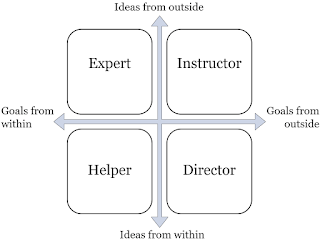
In 2008 I developed the 4 Progress-Focused Roles model (4PR model) together with my colleague Gwenda Schlundt Bodien (with whom I also, 4 years ago, co-developed the progress-focused approach as a whole). The model describes four different roles from which progress-focused professionals may work: helping, directing, training/advising, and instructing. It is a two-dimensional model which describes these four roles which apply in conversations.

The basement metaphor: finding past successes in the basement of our brain

One of the important parts of the progress-focused approach is to make visible what has worked in the past. Progress-focused coaches, for example, ask their clients questions about their past successes. When those clients find examples of past successes they generally become more positive and optimistic. Furthermore, they often come up with some ideas about how they might take a step forward. This might sound a bit strange. Why would something which has worked before not be visible right away? Why should you make an effort to make it visible? You have already experienced it, haven't you? And it was a positive experience. Why wouldn't you remember it, anyway? 

8 Principles in progress-focused change

Image
Progress-focused principles and techniques are not only useful in individual conversations and team facilitation processes but also in facilitating organizational change. Here are a few principles I propose for organizational change. Share decision making / work as participatively as possible: change is acceptable when people feel that they can (at least partly) influence or even determine what the change is and how it is shaped. 

Silver lining theories increase performance

Image
A new paper suggests that believing that negative personal characteristic tend to be associated with positive sides benefits one's performance. Here is the abstract of that paper. Holding a silver lining theory: When negative attributes heighten performance  - Alexandra Wesnouskya, Gabriele Oettingen, Peter Gollwitzer (2014)  Abstract : Holding a lay theory that a negative personal attribute is associated with a positive attribute (i.e., a silver lining theory), may increase effortful performance in the domain of the positive attribute.

Usefulness questions in conflict resolution

Image
Usefulness questions belong to the most popular progress-focused techniques. Here are two ways in which you, as a progress-focused mediator, can make them extra helpful in conflict resolution.  Progress-focused principles and techniques are quite useful in conflict resolution. Some previous articles in which I provided some examples are here  and here . A question which is particularly helpful is the usefulness question. It can be asked in roughly two types of ways. The first way of asking focuses on the most useful way the time can be spent during the conversation. For example, it can be asked as follows: "How do you think we can use our time today as useful as possible?" The second way of asking focuses on the desired outcome of the conversation. It can be asked as follows: "After our conversation, how would you notice it had been helpful to you? These two forms of usefulness questions can be asked in combination with each other in a conversation. They complement e...

When to interrupt?

Image
In progress-focused conversations you will not often interrupt your conversation partner. Sometimes, however, you will deliberately interrupt. Here, I explain when and how you may do that.  As a rule, progress-focused coaches and managers do not interrupt their conversation partners during conversations. They ask questions, listen attentively, encourage, and respond respectfully to what is said. Because of this, their conversation partners will feel that their perspective is taken seriously and that they have time to think calmly about what is important to them.

Are you autonomously motivated?

Image
By providing autonomy-support to others you can help them a lot. But what do you do when your own motivation isn't so autonomous?  Yesterday, we did a workshop progress-focused management with approximately 25 directors and team leaders of a group of schools. One of the topics we talked about was autonomy support. As a reader of this website, you probably know that self-determination theory distinguishes autonomous motivation from controlled motivation. For new readers, here is a brief summary.

Swinging between problematic present and desired future

Image
Swinging back and forth between acknowledgement of current problems and visualizing a better future makes it possible to contain energy for change. Progress usually -perhaps always - begins with a certain dissatisfaction with the current situation. This dissatisfaction with the current situation springs from the realization that things are worse than they could be. In other words, you can imagine a reality which is better than the current reality. Because people are aware of their dissatisfaction with certain aspects of their situation they can start to look for ways of improving those aspects. Their dissatisfaction with their current situation is a tension which can be seen as energy for change . To be able to work effectively on progress, it sounds a bit paradoxical, you need to be able to live with the awareness that you are now living in a reality that needs improvement.

Progress-focused summarizing

Image
Progress-focused professionals often summarize what their conversation partners have said. The summary is spoken in what is sometimes called a tentative tone . This means that the tone is not firm and assertive but it is as if there is a little question mark at the end of each sentence. This makes it easier for the conversation partner to feel free to make any corrections, if needed, to the summary.

Progress-Focused Directing

Image
Progress-focused directing is a technique which we developed around 2005. It can sometimes be quite useful for managers, teachers, and parents. It can be used in situations in which individuals have to conform to certain rules or have to accomplish goals. The approach is intended to help individuals understand what the rule or goal is and why it is important and to activate them to start finding their own ways to make progress in the desired direction. When do you use it? This type of providing direction fulfills two kinds of functions: (1) clarifying expectations, (2) setting limits. Clarifying expectations is an important part of managing, teaching and raising kids. Anyone who is part of a social system (a society, an organization, a school, a family) has to adapt to and to some degree conform to certain expectations in order to function and develop well and to make a valuable contribution.

The tilt intervention for working with involuntary clients

Image
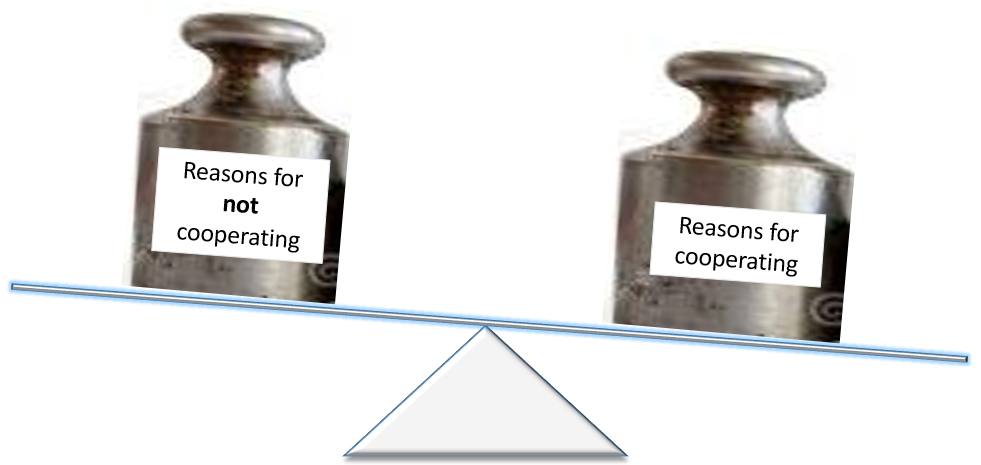
In coaching, supporting the autonomy of clients is extra important with involuntary clients. Involuntary clients are clients who's own idea it wasn't to go to a coach but who were sent by someone else. Although these clients may at first be reserved or uncooperative it is usually possible to reach a good cooperation with them rather fast. The key to doing that is to recognize their perspective and to acknowledge and accentuate their autonomy.

Are progress-focused skills just conversational tricks?

Image
In a recent training group I had been teaching participants about several progress-focused techniques such as the NOAM 7 steps  approach , the progress-focused circle technique , the positive no technique , and progress-focused directing (which is a way of making your expectations clear in a motivated and constructive manner). On the second day of the training, one of the participants made a remark which was something like this: "First of all, I really find all of this interesting and useful but I am wondering about something. If both we employees and managers learn progress-focused skills aren't both parties just becoming better at conversational trickery? First my manager will try to make a clever formulation to try to get me to do something and then I will counter that will some clever formulation of the positive no technique. It feels just like we are just applying tricks? I just don't think we will still be able to be honest and spontaneous!"