Posts

Showing posts with the label negative

How do you deal with someone who is very negative?

Image
During a recent training that we gave to managers, we discussed research by Teresa Amabile on inner work experience. One of the implications of Amabile's research is that, as a manager, it is wise to try to limit negativity in your own communications. When we addressed this, one participant asked, “But how do you deal with someone else who is very negative?” This question is understandable and provides a valuable opportunity to reflect on the topic of negativity.

Two components of positive communication

Image
Negativity in conversations can put a strain on relationships and can make cooperation harder. Negativity, such as criticism and blame, can make people defensive . While they are in a defensive state of mind, their ability for nuanced and creative thinking is temporarily reduced. Instead, they may try to justify their own behavior or launch a counterattack. Whenever people feel they are approached negatively their reflex is to respond negatively. Both the content of what they say and the way they are saying it is likely to become more negative.

When is positive feedback more motivational and when negative feedback?

Image
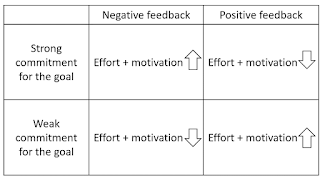
Constructive feedback, both negative and positive, can play an important role in goal achievement. Previous research by Koo and Fishbach (2008) demonstrated that feedback can signal two kinds of messages. The first type of message is about commitment: it can say something about whether your goals are valuable and whether you have a good change of achieving them. Individuals which are not strongly committed to a certain goal can become more motivated after receiving positive feedback (and less after receiving negative feedback). The second message is about progress: feedback can say something about whether you have put in enough effort and whether you have achieved enough progress. Strongly committed individuals tend to get more motivated by negative feedback and less motivated by positive feedback (see the figure on the right). By the way, with negative feedback I do not mean personal criticism or blame but constructive information about what is not going well yet and what could b...

Feigning anger is an unwise tactic

In progress focused work we argue for positive, goal oriented ways of communicating. As much as possible we try to avoid negative expressions such as anger or blame because these generally needlessly threaten both the issue and the relationship. Sometimes people ask whether such negative communication might be effective or even necessary in certain situations. They argue that these negative expressions might create a sense of urgency and pressure in your conversation partner to go along with your expectations. Based on this idea they may even argue that feigning anger is a good way to get people to go along with your expectations. This tactic, according to them, could be applied in conflict situations, negotiations and in conversations in which performance expectations need to be clarified.

The plus behind the minus: which questions can you ask?

Image
Several years ago, I introduced the technique of ' finding the plus behind the minus '. The basic I idea behind it is that when people express themselves negatively (through a complaint, a reproach, or criticism) there is always something positive behind that negative expression. That positive thing is something which they find valuable or important, a value, a principle, a goal, of whatever you want to call it. Briefly, the technique comes down to searching for that plus behind the minus. In our progress-focused training programs we frequently practice this technique with our participants, especially in cases which deal with resistance of conflicts. When you are trying to help people in a conflict situation to express the plus behind their minus this has several benefits. First, they themselves find it helpful and pleasant to be able to explain more clearly what their preferred situation is. Second, it will be more acceptable and clear for the other person or people involved...

Ending downward spirals by replacing them with upward spirals

Image
One of the most interesting aspects of the book The upward spiral by Alex Korb is thinking in terms of downward and upward spirals in human functioning. The concept of a spiral is based on what is called a positive feedback loop, a loop of cause and effect which continues and amplifies itself. A simple example of a positive feedback loop is a microphone which is held closely to a speaker. It will pick up the sound of the speaker and amplifies that again and again and again. The result is a shrill high tone. In human functioning these positive feedback loops can also happen in all kinds of ways. When the consequences of such positive feedback loops are negative we may speak of downward spirals; when they are positive of upward spirals. Such spirals can happen in many areas of life. I will give some examples. 

The plus behind your own minus

Image
Making negative remarks in conversations usually does not work too well.  When, as a manager, you start the conversation by pointing out in detail what the employee has done wrong you risk that the other person will become defensive. And when you have a disagreement with someone and start to criticize this person there is big chance that you will be criticized right back. When people are confronted with negative expressions like criticism they often become tense and reply negatively. In the brain it can be observed that when people are confronted with negative conversational behaviors, cortisol is produced which makes us more defensive and less nuanced. Your negativity provokes negativity in the other person. Put differently, if you give the other person a minus, he is likely to give you a minus in return.

Silver lining theories increase performance

Image
A new paper suggests that believing that negative personal characteristic tend to be associated with positive sides benefits one's performance. Here is the abstract of that paper. Holding a silver lining theory: When negative attributes heighten performance  - Alexandra Wesnouskya, Gabriele Oettingen, Peter Gollwitzer (2014)  Abstract : Holding a lay theory that a negative personal attribute is associated with a positive attribute (i.e., a silver lining theory), may increase effortful performance in the domain of the positive attribute.

How to decrease the harmful effects of negative team relationships

Image
What can you do to decrease the harmful effects of a negative team atmosphere?   A negative team atmosphere and negative relationships between team members can harm both employees' job satisfaction and team performance. Researchers De Jong et al. (2014) compared three different ways of dealing with such problems. They called the first approach communication density with which they meant that team members had frequent contact with one another and tried to improve the atmosphere. The second approach which was called member exchange referred to team members assisting one another, and giving help and feedback to one another when needed.

Utilizing the principle of reciprocity seeking in progress-focused coaching and mediation

Image
Human nature not only has a competitive side to it, which expresses itself through tendencies such as resource striving and status seeking ; it also has an equally important, if not more important, cooperative side which expresses itself through tendencies such as fairness and reciprocity seeking and group identity seeking (for more about this read The dual human nature: competitive and cooperative forces ). Here, I want to focus on one of those cooperative tendencies, namely  reciprocity seeking . The principle of reciprocity seeking, which has a strong impact how we behave in social interactions, implies that if someone else does us some kind of favor we want to give a favor in return to that person. Negative reciprocity, by the way, means that if we feel that someone treats us badly, we want to treat them badly in return. In other words, we tend to want to give back what we feel we get.

Careful with that coping question

Image
One type of question which progress-focused coaches ask is the coping question. This question is mainly used when coachees experience their circumstances as really hard and more or less hopeless. The basic for of this type of question is: How do (/did) you manage to go on under such difficult circumstances? But there are many different ways in which the question can be asked, such as: