Posts

Showing posts with the label expert

When is positive feedback more motivational and when negative feedback?
Image
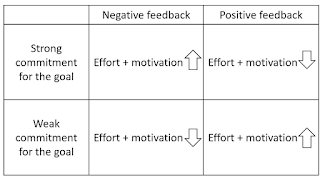
Constructive feedback, both negative and positive, can play an important role in goal achievement. Previous research by Koo and Fishbach (2008) demonstrated that feedback can signal two kinds of messages. The first type of message is about commitment: it can say something about whether your goals are valuable and whether you have a good change of achieving them. Individuals which are not strongly committed to a certain goal can become more motivated after receiving positive feedback (and less after receiving negative feedback). The second message is about progress: feedback can say something about whether you have put in enough effort and whether you have achieved enough progress. Strongly committed individuals tend to get more motivated by negative feedback and less motivated by positive feedback (see the figure on the right). By the way, with negative feedback I do not mean personal criticism or blame but constructive information about what is not going well yet and what could b...
The 4 Progress-Focused Roles Model (4PR model)

Image
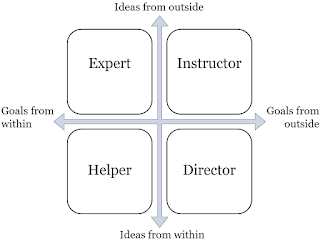
In 2008 I developed the 4 Progress-Focused Roles model (4PR model) together with my colleague Gwenda Schlundt Bodien (with whom I also, 4 years ago, co-developed the progress-focused approach as a whole). The model describes four different roles from which progress-focused professionals may work: helping, directing, training/advising, and instructing. It is a two-dimensional model which describes these four roles which apply in conversations.

Do recent publications prove Anders Ericsson and colleagues wrong about the importance of deliberate practice? No.

Image
About deliberate practice I have written much about deliberate practice . Researchers have demonstrated there is a lack of evidence for the claim that natural ability is the main factor behind top performance. They have found out that what is crucial instead is the amount of time the individual has practiced and the specific way in which he or she has practiced (read more about deliberate practice here and here ). Recently, two articles were published on the relative importance of deliberate practice and 'talent' for achieving high levels of performance. First, there was Deliberate Practice Is Necessary but Not Sufficient to Explain Individual Differences in Piano Sight-Reading Skill by E. Meinz and D. Hambrick. Second, there was  Deliberate Practice: Necessary But Not Sufficient   by G. Campitelli and F. Gobet. Do these articles shed a new light on how important deliberate practice is? Do they call for a return to the idea that innate abilities are, in the e...