Posts

Showing posts with the label Wisdom

Research updates Sep-Oct 2023

Image
Here are some recent research updates relevant to the progress-focused approach:

Interview with Judith Glück

Image
Judith Glück is a professor of developmental psychology at the University of Klagenfurt in Austria. She is one of the leading scholars in the emerging field of wisdom science. She started studying this topic 20 years ago where she worked with wisdom science pioneer Paul Baltes at the Max Planck Institute in Berlin. Her research has focused on how laypeople view wisdom, how wisdom develops, how it can be measured, on situational determinants of wisdom, and on the relationship between wisdom and values and intuitions. Together with her longtime collaborator Susan Bluck she introduced the MORE Life experience model of wisdom . In this interview I ask here about a variety of topics such as what wisdom science is, what wisdom itself is, why wisdom may now be more needed than ever in the world, and how wisdom science may contribute to progress in the world. Hi Judith, I think I read somewhere that people have written about wisdom practically since the invention of writing some 5000 years ...

Wisdom and values: does what we value determine how we think about wisdom?

Image
Wisdom is something to pursue. Many people would like to be able to act wisely in complex situations. And for many people it is an attractive perspective to, as they get older, become wiser. But what  precisely do we mean when we talk about wisdom? May what we call wisdom merely be a reflection of our personal values? May what one person views as wise be something completely different from what the other views as wise? In this article I discuss research from Glück, et al. (2021) which gives some interesting answers to these questions.

Can you cultivate wisdom in work situations?

Image
Whether you see the benefit of cultivating wisdom in work situations depends on whether you believe that wisdom can be developed at all. Recent experimental research has shown that the important components of wisdom are indeed malleable. In a new book chapter, Igor Grossmann (2020) lists what is known about the malleability of wisdom. He also offers suggestions for how wisdom can be cultivated at work. 

Interview with Igor Grossmann

Image
Igor Grossmann was born in the Soviet Union, grew up in Ukraine and Germany, and studied in Germany and the USA. Currently, he is the director of the Wisdom and Culture Lab at the University of Waterloo, Canada. He is one of the leading researchers in the field of wisdom research (view his Google Scholar profile ). His work focuses on demystifying wisdom and modeling of cultural change. He also co-hosts the On Wisdom Podcas t and initiated worldaftercovid.info . In this interview we will talk about topics like what wisdom is, why there now appears to be an ever-greater call for wisdom, how individuals may reason and act more wisely, and how wisdom may be taught. 

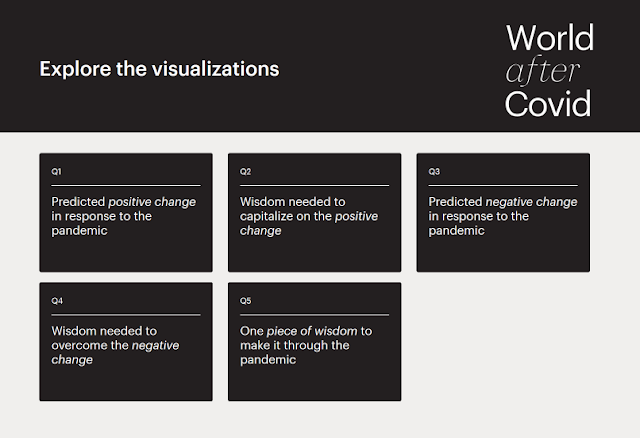
World After Covid website: scholars' answers to 5 questions

Image
Igor Grossmann has interviewed more than 50 prominent behavioral and social scientists from around the world to forecast the World after Covid , and share their advice on the wisdom people can use now to make it a better place. 

Leadership humility leads to follower authenticity

Image
A study by Oc et al. (2019) looks at the relationship between the humility of managers and the authenticity of employees. Their finding: leaders' humility leads to followers' authenticity. Read more.

4 Elements of Wise Leadership

Image
Who still wants to have a leadership role in a large organization in these complex times? The role of leaders seems quite challenging. To begin with, organizations themselves are often extremely complex. As a leader within organizations, you are faced with all kinds of problems, differences of opinion and diverse interests. As a leader, how can you ever have the information, knowledge and skills to bridge these contradictions and to find solutions to these problems? In addition to that, consider the environments in which organizations have to operate. These are also characterized by enormous complexity, change and uncertainty. As a leader in all this turbulence, how can you ever know for sure which way the organization should go? Doesn't being a leader require almost superhuman energy, capabilities, and social skills? 

How wisdom is needed to solve complex problems

Image
Traditionally, philosophers have studied wisdom. But within psychology, this subject has received relatively little attention until recently, especially when compared to a subject like intelligence. But this has changed in recent years. There has been more consensus on what we mean by wisdom, to what extent it occurs in humans and what it correlates with. Grossmann & Brienza (2018) describe in a new article how wisdom can make a unique contribution to solving the complex issues of our time.  

A common model of wisdom

Image
Both in our own everyday life and in society, we are often confronted with important issues that are difficult to solve with knowledge and rationality alone. The reason for this is that these issues are complex, surrounded by a great deal of uncertainty and often involve different perspectives and interests. Consider how to deal with the Corona crisis, the rise of artificial intelligence and the possible ethical consequences, political polarization and the spread of misinformation. Many philosophers and psychologists think that wisdom is necessary to tackle these kinds of issues effectively. But what is wisdom?

Wisdom is associated with well-being

Image
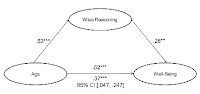
Are people with stronger cognitive abilities happier? Previous research into this question led to inconclusive results. Researchers Grossman et al. (2013) suspected that this was because this research primarily looked into the relation between intelligence and well-being and not to other qualities such as wisdom. That is why they did a study with 241 people in which they investigated the relationships between 5 variables: 1) intelligence, 2) wisdom, 3) personality, 4 age, and 5) well-being. Wisdom was measured through a structured interview method; the other variables were measured using validated tests and scales.

Everyday wisdom is not a stable personality trait

Image
Igor Grossman and Ethan Kross (2014) showed that people, by looking at their own problems from a distance (from a third person perspective), can come to wiser judgments ( read more about their studies ). A new study by Grossman et al. (2016) focuses on the question how stable or dynamic wisdom is in daily life. The researchers did a daily diary study into wise reasoning which lasted 9 months with 152 participants and which asked people to reflect on problems which that had had the previous day. They measured 3 facets of wisdom: intellectual humility, self-transcendence (being able to view your situation from a distance), and consideration of others’ perspectives/compromise.

New possibilities for progress at a higher age?

Image
An assumption in the progress-focused approach is that all people can make progress wherever they are. For children, this is easy to understand. They are constantly learning and exploring and we constantly see them make fast progress and in many ways. Middle aged people also show all sorts of progress both in their private lives and in their careers. From age 30 to 40 we begin to see clear signs that some physical and cognitive functions no longer progress but actually start declining. Does this mean that everything is destined to go downhill from that age on? No, this is a too pessimistic view. Recent publications (for example this one and this one ) show that certain capabilities indeed decline from a certain age but other capabilities peak at a higher age and some do not peak at all (they can continue to grow stronger). Harvard researcher Laura Germine summarize how cognitive capabilities peak at different ages in this picture:

Looking wiser at your situation by taking some distance

Image
By looking at your problems from a distance, by taking a third person perspective, you may come to wiser judgments. A powerful tool for making progress in many situations in the perspective-change technique. This tool enables you to look at your situation from a third person perspective. In progress-focused coaching we use this principle by asking perspective-change questions. An example of such a question is: "How would other people notice your situation will have improved?" In this article I describe evidence for the motivating effect of visualizing such a third person perspective. In this article I describe how you can use perspective changes to prepare for difficult conversations. A new publication demonstrates that it is easier to come to wise judgments when taking a third person perspective.