Posts

Showing posts with the label Questions

World After Covid website: scholars' answers to 5 questions

Image
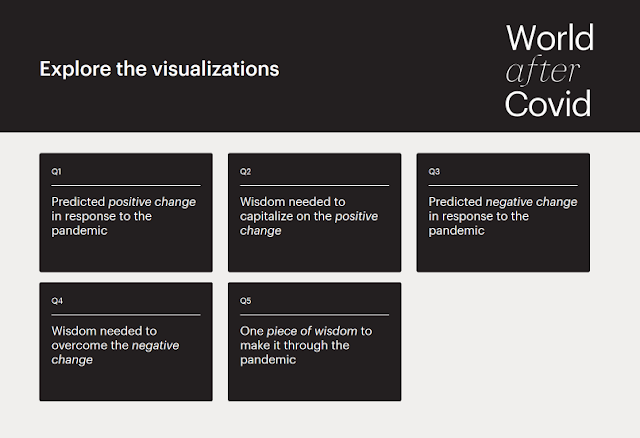
Igor Grossmann has interviewed more than 50 prominent behavioral and social scientists from around the world to forecast the World after Covid , and share their advice on the wisdom people can use now to make it a better place. 

The strategic mindset improves strategies and performance

Image
  Patricia Chen and colleagues introduce a new concept: the strategic mindset. This mindset appears to be useful when we are dealing with new tasks or setbacks.

Progress-focused intervision: fast and useful

Image
Progress-focused intervision can help teams to reflect on a case and to get some good ideas for progress within about 20 minutes. One person presents a case and the rest of the team are in a helping role. The approach has some rules and steps which I will describe below. It usually works best if the rules and steps are followed rather closely and if the process proceeds rather quickly. After all the steps have been taken there is no further discussion of the case.

Checklist: 7 questions to support your professional development

Image
What role does experience play in our professional development? We often think that how long people have been doing something determines how good they are at it. Of course, that thought can't be completely wrong. We can't say that there is no relationship at all between how long you have been doing something and how good you are at it. Someone who has been playing the piano for just a few weeks can't be very good at it yet. Learning the basic skills requires a certain time. But the relation between how long we have been doing something and how good we are at it is different than we often assume. Take as an example driving a car. When both my sons were doing their driving lessons, these last few years, they could precisely point out to me the many little mistakes I made while driving. I have been doing it for 35 years and thought I was reasonably good at it. But because of the many small reprimands by my sons, I have come to realize that many little mistakes have crept int...

10 Questions to help you fulfill your basic needs

Image
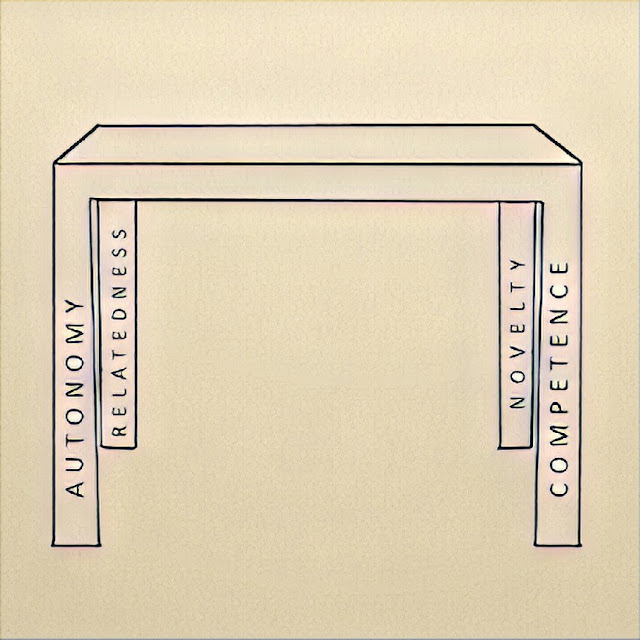
Self-determination theory distinguishes three universal basic psychological needs, the need for autonomy, for competence, and for relatedness. The fulfillment of these needs is necessary for us to feel well and function well. The need for autonomy refers to the experience of being able to make your own choices and to stand behind what you are doing. The need for competence refers to the experience of being effective and capable of achieving desired outcomes. The need for relatedness refers to the experience of a mutual connection with and care for important people your life. Recent research by González-Cutre et al. (2016 ) indicates there may be a fourth basic need: the need for novelty, the need to keep on experiencing new things which deviate from your daily routine.

3 Types of harm from irrational beliefs

I define irrational beliefs as beliefs which are incoherent or logically inconsistent and which are in conflict with what we know about reality (in conflict with available evidence, that is). Nobody is free from irrational beliefs. Our way of interpreting reality is not and never will be perfect. We are afflicted with systematic biases in how we perceive reality. Furthermore, through our upbringing and culture, we all inevitably have, without us being aware of it, adapted beliefs which are outdated. That we have irrational beliefs does not mean we must acquiesce in that fact. Critically reflecting on your own beliefs is a good thing. It enables you to develop your view on the world and to make it more realistic. For several reasons that can be hard. In this post I described four factors which impede the process of changing our of beliefs: (1) the confirmation bias, (2) self-fulfilling prophecies, (3) labeling oneself based on one's beliefs, and (4) social pressure. Then, in ...

Activating a student

Image
I came across a beautiful example of activating a student in a progress-focused manner.  Tina teaches high school students in a special boarding school. During the brief period (usually several months) in which these students are at the boarding school they work independently on their subjects most of the time and whenever they need some help or explanation Tina and their colleagues provide it to them. Of course, every now and then the students also have to take tests. Tina frequently uses progress-focused principles and techniques such as growth mindset interventions and autonomy supportive interventions. Every day, she writes brief observation/reflection diary entries, both for her own purpose and to inform her colleagues about what happened on that day. I have read and remembered one of the recent entries in that diary. I went something like this.

The plus behind the minus: which questions can you ask?

Image
Several years ago, I introduced the technique of ' finding the plus behind the minus '. The basic I idea behind it is that when people express themselves negatively (through a complaint, a reproach, or criticism) there is always something positive behind that negative expression. That positive thing is something which they find valuable or important, a value, a principle, a goal, of whatever you want to call it. Briefly, the technique comes down to searching for that plus behind the minus. In our progress-focused training programs we frequently practice this technique with our participants, especially in cases which deal with resistance of conflicts. When you are trying to help people in a conflict situation to express the plus behind their minus this has several benefits. First, they themselves find it helpful and pleasant to be able to explain more clearly what their preferred situation is. Second, it will be more acceptable and clear for the other person or people involved...
The basement metaphor: finding past successes in the basement of our brain

One of the important parts of the progress-focused approach is to make visible what has worked in the past. Progress-focused coaches, for example, ask their clients questions about their past successes. When those clients find examples of past successes they generally become more positive and optimistic. Furthermore, they often come up with some ideas about how they might take a step forward. This might sound a bit strange. Why would something which has worked before not be visible right away? Why should you make an effort to make it visible? You have already experienced it, haven't you? And it was a positive experience. Why wouldn't you remember it, anyway? 

The plus behind your own minus

Image
Making negative remarks in conversations usually does not work too well.  When, as a manager, you start the conversation by pointing out in detail what the employee has done wrong you risk that the other person will become defensive. And when you have a disagreement with someone and start to criticize this person there is big chance that you will be criticized right back. When people are confronted with negative expressions like criticism they often become tense and reply negatively. In the brain it can be observed that when people are confronted with negative conversational behaviors, cortisol is produced which makes us more defensive and less nuanced. Your negativity provokes negativity in the other person. Put differently, if you give the other person a minus, he is likely to give you a minus in return.

Progress-Focused Directing

Image
Progress-focused directing is a technique which we developed around 2005. It can sometimes be quite useful for managers, teachers, and parents. It can be used in situations in which individuals have to conform to certain rules or have to accomplish goals. The approach is intended to help individuals understand what the rule or goal is and why it is important and to activate them to start finding their own ways to make progress in the desired direction. When do you use it? This type of providing direction fulfills two kinds of functions: (1) clarifying expectations, (2) setting limits. Clarifying expectations is an important part of managing, teaching and raising kids. Anyone who is part of a social system (a society, an organization, a school, a family) has to adapt to and to some degree conform to certain expectations in order to function and develop well and to make a valuable contribution.

15 Inspiring quotes from 'How life imitates chess' by Garry Kasparov

Image
In 2007, Garry Kasparov, one of the greatest chess players ever, wrote the book How life imitates chess . In that book he looked back on his great career and he made comparisons between life and chess. The book contains some inspiring thoughts. Here are some quotes: You must know what questions to ask and ask them frequently Personal style is not generic software that you can download. You must instead recognize what works best for you and then, through trial and error, develop your own method- your own map.

Combining practice based learning and theory based learning

Image
As mentioned before on this site, I am rather reluctant about the usefulness of a giving advice - especially unasked-for advice. In general my assumption is that self-found internal solutions , solutions which are based on people's own experience and which they can apply themselves without help or training by others, are the most motivating way forward in many situations. By the way, from this, it does not follow that we can't help other people. We can actually help people identify their own internal solutions. But the way to do this is not to offer them judgments and advices. Instead, through a process of asking carefully chosen questions and interventions people can, in many cases be helped to find their own solutions to problems ( here is an example of how such a helping strategy may be designed).