Posts

Showing posts with the label Feedback

Asking for Feedback as a Manager

Image
A manager in our training said that he was going to ask employees for feedback. It was about the following topic. Research by Teresa Amabile and Steven Kramer shows that a positive inner work experience has to do with how positively you feel about your work, how good you feel at work, and that you have the feeling that your work matters. This work experience largely determines how well you function, also as managers. We gave our managers a checklist with examples of actions they could take to increase the positive inner work experience of their employees. We also gave the checklist examples of actions that undermine employees’ inner work experience and that they should therefore avoid.

The illusion of transparency

Image
We think we know that how we perceive reality is really what that reality is like. But research from about the last 50 years has shown in countless ways that our perception and reality are sometimes much less alike than we think.  How we subconsciously perceive reality in a distorted way has all kinds of consequences (often negative) for our choices and our social behavior. In this article I want to talk about a not so widely known bias: the illusion of transparency.

How do you address each other? A situational communication model

Image
In most professions the quality of work performance depends mainly on human actions. In this human action, not only technical knowledge and skills are important, but also cooperation and communication skills. Collaboration is often important because people are usually responsible for achieving results together. They have to inform each other, support each other, teach each other things and clarify expectations. The situational communication model below can help you determine how to communicate effectively in different situations.

Four questions to make your feedback as effective as possible

Image
Feedback can be very valuable. Feedback, information about the effects of our behavior, can help us get better at what we do. By definition, we ourselves only have a limited insight into the effects of our actions. Other people look at what we do from a different perspective and can therefore see different things. Moreover, they may have more or different knowledge and skills, so that their feedback can be extra educational for us. Whether these positive effects of feedback are realized depends on what the feedback is about and how effectively the feedback is delivered. Here are some questions to make your feedback as effective as possible.

Mueller & Dweck (1998) Classic Study: The Undermining Effects of Intelligence Compliments

Image
One of the most influential papers by Carol Dweck and her colleagues is the Mueller & Dweck (1998) paper entitled Praise for Intelligence Can Undermine Children's Motivation and Performance . Over the years, this study has been criticized or disputed from various quarters, sometimes largely justified , sometimes largely unjustified. Knowing these criticisms, I argue that Mueller & Dweck (1998) is a classic publication that has lost little or nothing of importance. Here you can read a brief description of that research.

How teachers can combine autonomy-support with structure

Image
Autonomy support is effective in parenting, in teaching, and in leadership at work. Some incorrectly think that a remark like this should be read as a plea for 'anything goes'. Autonomy support does not mean that no structure is offered. Autonomy support and structure go hand in hand. Offering structure strengthens the perception of autonomy and is even often a prerequisite for it. I elaborate this thought using the context of education as an example.

Which types of goals when?

Image
There are different types of goals. What are the differences and when does which type of goal work best? In a new article, Latham & Seijts (2016) summarize the findings of goals-setting theory (GST; Locke & Latham, 1990 ; 2013 ), a well supported theory about how goals work. GST-research has shown that setting specific, challenging goals lead to higher performance than easy and abstract goals. The general rule is that higher goals lead to higher performance providing four conditions have been met: the individual is competent for the goals, has sufficient situational resources, is committed and receives objective feedback on goal progress.

When is positive feedback more motivational and when negative feedback?

Image
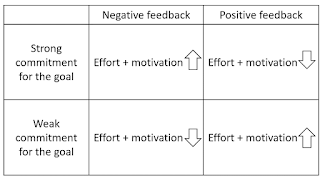
Constructive feedback, both negative and positive, can play an important role in goal achievement. Previous research by Koo and Fishbach (2008) demonstrated that feedback can signal two kinds of messages. The first type of message is about commitment: it can say something about whether your goals are valuable and whether you have a good change of achieving them. Individuals which are not strongly committed to a certain goal can become more motivated after receiving positive feedback (and less after receiving negative feedback). The second message is about progress: feedback can say something about whether you have put in enough effort and whether you have achieved enough progress. Strongly committed individuals tend to get more motivated by negative feedback and less motivated by positive feedback (see the figure on the right). By the way, with negative feedback I do not mean personal criticism or blame but constructive information about what is not going well yet and what could b...

Written feedback using the plus, the arrow, and the question mark

Image
Giving written feedback using the plus, the arrow, and the question mark can make your feedback more useful and the process of giving feedback more pleasant. Many people frequently receive written feedback to what they have written themselves. Written feedback can fulfill an important function. Other people may have more knowledge and a different perspective which may enable you to learn from them. Also, feedback may help you check whether what you have written is clear and comes across as you intended.

Feedback in Three Steps

Image
© 2003, Coert Visser As a manager you have just led a meeting. John brought forward a proposal to implement a Customer Relationship Management (CRM) system. He did this convincingly and enthusiastically but seemed to leave very little room for his colleagues Michael and Peter to respond. You want to talk to John about this...but how?

Ending downward spirals by replacing them with upward spirals

Image
One of the most interesting aspects of the book The upward spiral by Alex Korb is thinking in terms of downward and upward spirals in human functioning. The concept of a spiral is based on what is called a positive feedback loop, a loop of cause and effect which continues and amplifies itself. A simple example of a positive feedback loop is a microphone which is held closely to a speaker. It will pick up the sound of the speaker and amplifies that again and again and again. The result is a shrill high tone. In human functioning these positive feedback loops can also happen in all kinds of ways. When the consequences of such positive feedback loops are negative we may speak of downward spirals; when they are positive of upward spirals. Such spirals can happen in many areas of life. I will give some examples.