Posts

Showing posts matching the search for fixed mindset

Cultures of growth: the many benefits of growth mindset cultures

Image
Mary Murphy , professor of psychology at Indiana University, has published the book Cultures of Growth . In 2006, she was a student of Carol Dweck , the founder of mindset theory. Dweck's previous work showed that people with a growth mindset are more likely to take on challenges, learn from mistakes, and achieve more in the long run than people with a fixed mindset. Murphy suggested that not only individuals but also environments embody a mindset. Nearly two decades later, Murphy and her colleagues have conducted extensive research in numerous organizations. Cultures of Growth reports on this.

Organizational mindset: what are its characteristics and consequences?

Image
Carol Dweck's mindset theory is usually associated with individuals: do they see individual abilities and traits as malleable or not? But there is also such a thing as a mindset culture. A mindset culture reflects shared ideas in an organization about the malleability of capabilities. In a fixed mindset culture there is the belief that abilities cannot be developed. In a growth mindset culture, there is a belief that abilities can be developed through effort. Organizational mindsets can affect the thinking and acting of individuals in those organizations in important ways.

Three findings on growth mindset cultures in organizations and classrooms

Image
Broadly speaking, there are two ways to think about the malleability of our traits and capabilities. When we have a growth mindset , we see traits and abilities as developable. In a fixed mindset we see them as not or hardly capable of development. In addition to individual mindsets, there are also mindset cultures . Researchers Wallace et al. (2023) explored the impacts of these cultures, uncovering three findings about growth mindset cultures in organizations and classrooms.

How a fixed mindset is related to depression

Image
  Mindset is about more than learning and performing. A new paper by Seo, et al. (2020) shows how the relationship between a fixed mindset and internalizing symptoms (such as depression) comes about.

10 Growth mindset suggestions during the Coronacrisis

Image
The Coronacrisis is challenging for almost everyone and therefore particularly a period that requires a growth mindset.

Interview with Carol Dweck

Image
The Growth Mindset © 2006, Coert Visser Carol Dweck is a professor of Psychology at Stanford University. She is a leading expert in the field of human motivation and intelligence and through the years she has developed an extensive body of theory and research. This year, she has published a remarkable book called Mindset: The New Psychology of Success . The book is a true gem, not only because of the clarity of the writing and structure but also, and foremost, because of its important and useful message. This message is that the way you view your own intelligence largely determines how it will develop. In this interview I ask Carol Dweck about the book and about what the practical implications of her work are for managers. I’d like to start off with a question about the intriguing title of your new book ‘Mindset: The New Psychology of Success’. Can you explain what the importance of mindset is for success?

False growth mindset: Superficial parroting of growth mindset ideas

Image
A growth mindset is the belief that abilities can change. Having a growth mindset is beneficial for motivation and seeking challenges. But more and more researchers are concerned about the existence of a false growth mindset. Does it indeed exist? If so, what are its meaning, causes and relevance?

8 Growth mindset interventions

Image
Many of the participants in our training programs are especially interested in Carol Dweck's research into mindsets . They see the relevance of mindset and realize that a fixed mindset has many disadvantages while a growth mindset has many advantages. They are interested in learning how they can influence their own mindset and that of other people. Many of them are aware that person praise can evoke a fixed mindset and process praise can evoke a growth mindset. But they look for other way to influence mindsets. Here are several other ways.

The vicious circle of mindset and psychological stress

Image
The mental health of pupils and students has become an important topic of concern in recent years. The pressure to perform, social expectations, and learning challenges can place a heavy burden on young people. A recent study by Kroeper et al. (2024) provides insight into a crucial factor contributing to this stress: the perception of mindset in the classroom. They discovered a vicious circle of mindset and psychological stress.

5 Ways in which mindset is relevant to health care professionals

Image
In this article I explain why the growth mindset is an important pillar of the progress-focused approach . Next, I describe five ways in which the growth mindset is relevant to health care professionals.

The social contagiousness of mindsets

Image
All of us are constantly exposed to all kinds of stimuli from our environment which affect how we feel and how we think about ourselves and about the world. An example of how we are affected is our mindset. Some events, remarks, and expectations that come our way evoke a fixed mindset in us while others evoke a growth mindset. The prime example of this is the differential effect of different types of praise.

Answers to four critical questions about the growth mindset

Image
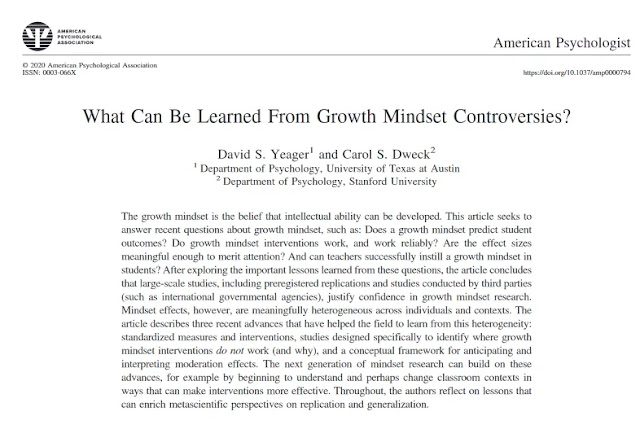
The growth mindset is the belief that personal characteristics such as intellectual abilities can be developed through effort and strategy. David Yeager and Carol Dweck have written an article which addresses four critical questions about the growth mindset:  Does a growth mindset predict student outcomes?  Do growth mindset interventions work and do they work reliably?  Are the effect sizes meaningful enough to merit attention?  Can teachers successfully be taught a growth mindset and instill a growth mindset in their students?  Below I summarize the article without going into all the finer points and arguments in the original article. Think of my summary as an introduction to the article and do read the article itself to get the details behind the arguments and conclusions of the authors. 

Relationship between mindset, basic psychological needs and well-being

Image
The mindset theory and the self-determination theory are two important pillars of progress-focused work. Within the progress-focused approach, we see both theories as important and complementary frameworks for understanding commitment, progress, and well-being. A new study also looks at the relationships between these two theories, in particular the interplay between mindset and basic psychological needs.

How teachers' motivation and mindset predicts how they teach

Image
A new study ( Vermote et al., 2020 ) examines how the motivation and mindset of higher education teachers (N = 357) relates to their teaching styles. This research is interesting for the following reasons: It investigates the circumplex model of motivational styles . Aelterman et al. (2019) have previously investigated and confirmed the circular structure in secondary schools. The current study does this in higher education,  It looks at the separate relationship between motivation and mindset on the one hand and teaching styles on the other.  Does teacher motivation predict their teaching style? Does the mindset of teachers predict their teaching style? Read answers to these questions below.

The synergistic mindsets intervention

Image
In this article I describe new research by David Yeager and his colleagues into how mindsets about abilities and mindsets about stress can reinforce each other, in a positive and negative sense.

How a fixed mindset about personality is related to depression and psychological distress

Image
Previous studies suggest that there is an association between a fixed mindset about personality and internalizing symptoms such as depression and psychological distress. To what extent does this relationship indeed exist and how might it come about?

"This is boring!" - sign of demotivation or of a fixed mindset?

Image
When students say "This is boring", does it indicate a lack of motivation? That is indeed possible but the remark can also be an indication of something else: a fixed mindset. In this video Carol Dweck explains that a fixed mindset makes it harder for people to deal with difficulty. When they find assignments difficult they can be fearful because they wonder whether they have the ability to do them right. This fear can manifest itself in different ways. One way is to directly express it. But often people with a fixed mindset will try to mask their fear. Because when we are in a fixed mindset it can be quite threatening to us to show that we don't believe we are able to do something or to learn something.

Study: growth mindset interventions by teachers work

Image
Underachievement in schools is a persistent problem. What role do students' beliefs about the developability of their own abilities play in this? And can these beliefs be influenced? And what role can teachers play in this? New research provides answers. 

Choosing better education and a growth mindset

Image
Recently I criticized an article by Alfie Kohn in which he criticized Carol Dweck. Whether Kohn does not understand the growth mindset well, and is not well informed about mindset research, or deliberately misleads, I don't know. But what he says, isn't true. I want to focus on one of his criticisms because it contains an especially misleading thought. Kohn suggests that promoting a growth mindset implicitly sends the message to just accept and adjust to the conditions we encounter instead of changing them. I'll explain why this is not true.

How mindset interventions can improve adolescent mental health

Image
How mindset interventions can improve adolescent mental health. A new paper by David Yeager and Carol Dweck raises the idea that adolescents have different perceptions of their personal qualities, and that changing these perceptions can lead to better coping with challenging situations and improved mental health. The paper presents both theory and data that support this idea.