Posts

Showing posts with the label training

How to talk so kids will listen & listen so kids will talk?

Image
As parents, we think few things are more important than that our children are doing well. Fortunately, through the way we raise them, we can have a significant impact on their mental health. In order to be able to use that influence properly, it is important to know what works well in parenting. Joussemet et al. (2018) are currently conducting research of which the results are not yet in. Their description of their research is interesting anyway because it provides insight into some key aspects of effective parenting.

Making psychological knowledge available to managers

Image
In an email I received the following question: “Do you have any ideas on how to deal with the fact that there is so much psychological knowledge that it is difficult for the typical manager to remember it in the moment, even if they have learned it? I keep leaning towards AI solutions, but that could be technophilia. ” Off the cuff I wrote an answer to his question:

Discomfort as a sign that you are learning

Image
About eight years ago my colleague Gwenda Schlundt Bodien and I did a big evaluation of our training courses. We wanted to find out what worked and what didn't in our courses. We send an e-mail to all participants who had attended our courses in the past years. We asked them to complete a brief survey in which we asked them which parts of our courses they had found most useful. On the list were items like: PowerPoint presentations, group discussions, video observations, practicing with other participants, practicing with the trainers, practicing with live clients, analyzing written dialogues, plenary discussion and explanations, reflecting team exercises, etc.

Review of Leadership BS by Jeffrey Pfeffer

Image
I have read many of Jeffrey Pfeffer's books and was looking forward to his new book Leadership BS: fixing workplaces and careers one truth at a time. Unfortunately, I think it is a disappointing book.  Stanford University professor Jeffrey Pfeffer has a provocative new book called Leadership BS: Fixing Workplaces and Careers One Truth at a Time . In the book he criticizes the leadership training industry which, he says, teaches that leaders should be trustworthy, authentic, serving, modest, and empathetic. But according to Pfeffer, there is no evidence that this leadership training does any good. In fact, he says it is harmful because it paints a much too idealistic picture of organizational reality and of the reality of leadership.

Are progress-focused skills just conversational tricks?

Image
In a recent training group I had been teaching participants about several progress-focused techniques such as the NOAM 7 steps  approach , the progress-focused circle technique , the positive no technique , and progress-focused directing (which is a way of making your expectations clear in a motivated and constructive manner). On the second day of the training, one of the participants made a remark which was something like this: "First of all, I really find all of this interesting and useful but I am wondering about something. If both we employees and managers learn progress-focused skills aren't both parties just becoming better at conversational trickery? First my manager will try to make a clever formulation to try to get me to do something and then I will counter that will some clever formulation of the positive no technique. It feels just like we are just applying tricks? I just don't think we will still be able to be honest and spontaneous!"

It can also be useful to look at what is outside of the outer circle

Image
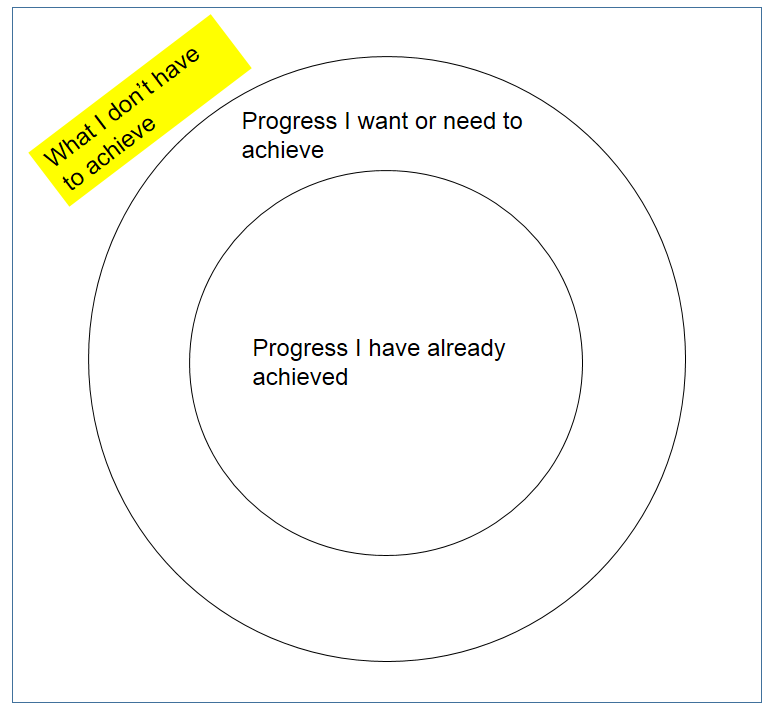
The progress-focused circle technique is getting more well-known and popular. It works like this: the coach draws two circles on a piece of paper or on a flip-over sheet, an inner circle and an outer circle. On small post-it notes clients write down what progress they have already achieved and then they hang them in the inner circle. Next, clients write on post-it notes what progress they further need and/or want to achieve and they hang these in the outer circle. Finally, clients choose which note(s) they first want to be able to move from the outer circle to the inner circle and how they will try to accomplish this. On the first day of a training I gave to a group of teachers I explained the circle technique and invited them to experiment a bit with it. I also gave an example of how I had once used the circle technique with a client of mine. What was interesting in that situation was that my client had not only hanged post-it notes in the inner and outer circle but also outside ...