Posts

Showing posts with the label self-regulation

The strategic mindset improves strategies and performance

Image
  Patricia Chen and colleagues introduce a new concept: the strategic mindset. This mindset appears to be useful when we are dealing with new tasks or setbacks.

Self-directed personality development

Image
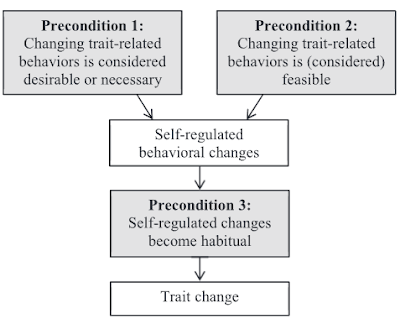
Personality traits are viewed as behavioral tendencies which are relatively stable over time and over a variety of situations. Both among lay people and psychologists there are many who think that changing one's personality substantially is hard or even impossible. This belief is primarily based on the observation that the personality of most people does not appear to change a lot during adult life. But a paper by Hennecke et al. (2014) suggests that self-directed personality change is possible. In the paper they explain why personality usually does not change much, why it actually can be done, and how it can be done.

Limited-resource view of willpower predicts low goal progress and low well-being

Image
Implicit theories about willpower predict subjective well-being by Katharina Bernecker, Marcel Herrmann, Veronika Brandstätter and Veronika Job (2015) Objective : Lay theories about willpower—the belief that willpower is a limited versus nonlimited resource—affect self-control and goal striving in everyday life ( Job, Dweck, & Walton, 2010 ). Three studies examined whether willpower theories relate to people's subjective well-being by shaping the progress they make towards their personal goals. Method : A cross-sectional (Study 1) and two longitudinal studies (Study 2 & 3) measured individuals' willpower theories and different indicators of subjective well-being. Additionally, Study 3 measured goal striving and personal goal progress.

Want-to goals make self-regulation easier than have-to goals

Image
The type of goals you have affects the amount of self-control you need to achieve them. When you want to achieve goals you need to be able to concentrate on the activities which help to make progress in the direction of those goals. This is not only the case with work-related goals (how can I finish that article on time?) but also with personal goals (how can I eat healthier?). Remaining focused on the activities needed to achieve goals requires that you can direct your attention. In the psychological literature this type of skill is usually referred to as self-regulation.

How do you get goals that work?

Image
Self concordant goals, goals that fit with your interests and values have many advantages. How do you get them? It is not only important that people set goals but also what types of goals they set. Within Self-Determination Theory the term self concordant goals has been introduced. Self concordant goals are goals which are consistent with the developing interests and values of the individual. When goals are self concordant people fully endorse these goals. They are autonomously motivated to pursue them.