Posts

Showing posts with the label rationality

How we keep on falling for untruths

Image
Recent years have shown many examples of how we can persist in believing things which are not true. A random selection of untruths which have remain popular with a surprisingly large group of people are: the idea that vaccines cause autism, that global warming is hoax (created by the Chinese), that homeopathy works, and that students each have a unique learning style which teaching should be adapted to. How is it possible that we so easily seem to fall for untruths?

A Plea for Broad Rationality

Image
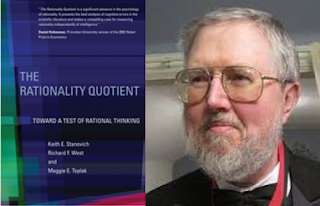
In The Rationality Quotient , which I have interviewed Keith Stanovich about recently, there is an interesting bit in which different conceptualizations of rationality are explained. Roughly there are two conceptualizations of rationality, a thin one and a broad one (a distinction which was first made by political scientist Jon Elster, 1983 ). The thin theory of rationality involves two factors of rationality: instrumental rationality and epistemic rationality.

Interview with Keith Stanovich (2016)

Image
The Rationality Quotient - Progress toward measuring rationality By Coert Visser I first interviewed Keith Stanovich , Professor Emeritus of Applied Psychology and Human Development at the University of Toronto, in 2009 . In that interview he explained the difference between intelligence and rationality and why rationality is very important. He also pointed out that IQ tests are incomplete measures of cognitive functioning because they do not measure rationality. Now, seven years later, I interview him about his new book, The Rationality Quotient , which he wrote together with his colleagues Richard West and Maggie Toplak , and which presents a prototype of a rational thinking test, the Comprehensive Assessment of Rational Thinking (CART).

How to defeat dangerous belief systems

Image
In this post I explained that there is, to some extent, a competition going on between the goals of our genes and our goals as an individual. As Keith Stanovich argues, building on Richard Dawkins' book The Selfish Gene , we humans have become aware of the fact that our genes' interests are not always in our own interests and that we can, at least to some extent, liberate ourselves from these genetic influences we do not serve us.

Our rebellion against our genes

Image
In 1859 Charles Darwin published his book The Origin of species in which he described a mechanism for the process of evolution of species for the first time. At its core the idea of evolution boils down to: the unity of life (all life is connected), the diversity of life, and the match between organisms and their environment can be explained by descent with modification through natural selection ( Vermeij, 2015 ).

4 Factors which impede change of beliefs

Image
Because beliefs have such great influence in our lives, it is important to be able to evaluate our beliefs properly and to keep developing them. Beliefs are malleable. We can find out that a belief we used to have is untrue and restricts us in our life. But changing our beliefs is not always easy. That is because, as people, we have certain obstacles which may impede changing our beliefs. I want to mention four of those obstacles.

The leftward drift

Image
I came across an intriguing bit in Richard Nisbett's book Mindware which was about what he called the leftward drift. This leftward drift refers to the fact that the number of college and university students who self-identify as liberal or far left in their political orientation increase as they move through college. At the same time, the number of students who call themselves conservative or far left decreases. In other words, college makes many students drift to the left in their political views.

5 Dimensions of belief systems

Image
Gerard Saucier of the university of Oregon has done research into belief systems of people. Belief systems are important because they guide people's behaviors and thereby influence their development and the circumstances in which they will find themselves. Saucier has created insight into what kind of belief systems there are. He did this using factor analysis. Through factor analysis it is possible to reduce a large number of variables to a more limited number of variables (factors; read more ). Saucier found out that the degree to which people vary in their beliefs can be describes using the following 5 dimensions ( Saucier, 2013 ).

Rationality taxonomy

Image
When I interviewed  Keith Stanovich  in 2009, he explained that intelligence tests are not good measures of good thinking because they do not assess the extent of rational thought. His research had shown that intelligence test scores, at best, only mildly predicted rational thinking an that some rational thinkin skills are totally dissociated from intelligence. Later in the same interview he said he had started to sketch out a framework for the assessment of rational thought. As a recent publication by Toplak, West, & Stanovich (2013) shows, there is now such a framework:

Interview with Keith Stanovich

Image
By Coert Visser Dr. Keith Stanovich, Professor of Human Development and Applied Psychology of the University of Toronto, is a leading expert on the psychology of reading and on rationality. His latest book, What Intelligence Tests Miss: The Psychology of Rational Thought , shows that IQ tests are very incomplete measures of cognitive functioning. These tests fail to assess rational thinking styles and skills which are nevertheless crucial to real-world behavior. In this interview with Keith Stanovich he explains the difference between IQ and rationality and why rationality is so important. Also he shares his views on how rationality can be enhanced.

What Intelligence Tests Miss: IQ and rationality are largely independent

Image
I am now reading an interesting book titled What Intelligence Tests Miss: The Psychology of Rational Thought by Keith E. Stanovich . The book is about the fact that IQ tests are incomplete measures of cognitive functioning. There is, as studies have show, in fact only a low to medium correlation between rational thinking skills and IQ test performance. And because rational thinking skills and IQ are largely independent it is not surprising that intelligent people can easily behave irrationally and hold false and unsupported beliefs. Several things are really interesting about this book. One is the authors insight that we do not need to stretch to non-cognitive domains (to notions as emotional intelligence or social intelligence) to see the lacunae in IQ tests. Another is the very specific and research based analysis of the topic matter. The author presents an elegant and rather comprehensive model of cognitive functioning in which three types of major thinking processes and their...