Posts

Showing posts with the label evolution

Pure altruism: does it exist?

Image
What does human nature look like? Are humans naturally good or bad? Are we selfish by nature or are we capable of purely selfless (altruistic) action? Are we mainly engaged in a constant battle with each other or is it more correct to say that we mainly work together and take care of each other? How we answer these kinds of questions for ourselves is quite important. Our answers to these questions determine to a large extent what we expect from ourselves and what we expect from others. And as a result, they also determine how we treat others and how we interpret behavior of others.

How to Argue with a Racist (book)

Image
Adam Rutherford, British geneticist and writer, has a new book, How to Argue with a Racist . I have read it and think it is an educational, interesting and well written book. It comes at a good time because there is now a lot of talk about racism and what to do about it. We often have conversations about race and racism based on our personal experiences, intuitions, norms and values, and common sense. This book adds something valuable in that it explains what the science of genetics and the science of evolution show about races and supposed differences between races. That makes the book very interesting. But I also have two critical thoughts about the book.

4 Surprising facts about epigenetics

Image
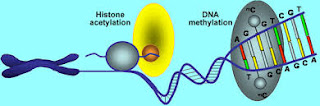
Some time ago, I wrote about a book by David Moore on epigenetics , a field in biology which now changes our understanding of the influence of genes. Epigenetics, briefly, means that, under the influence of the environment, certain molecules attach themselves to our chromosomes thereby affecting how our DNA functions and how we develop. While there are important developments in epigenetics, both laypeople and biologists remain skeptical about its significance. Based on the book by Moore, I explain below why I think that is wrong.

The Developing Genome – the rise of epigenetics

Image
A new book, The Developing Genome, describes the fascinating developments in the the field of epigenetics. These developments may require us to revise our beliefs about the influence of genes.

Our rebellion against our genes

Image
In 1859 Charles Darwin published his book The Origin of species in which he described a mechanism for the process of evolution of species for the first time. At its core the idea of evolution boils down to: the unity of life (all life is connected), the diversity of life, and the match between organisms and their environment can be explained by descent with modification through natural selection ( Vermeij, 2015 ).

Why psychology is harder than it seems

Image
It is understandable that exact sciences are generally viewed as the most difficult. But psychology may be harder in some ways.  One of my favorite science writers is Sean Carroll. He is a theoretical physicist at Caltech and author of the awarded book T he Particle at the End of the Universe which is about the discovery of the Higgs particle. Recently he surprisingly said: “Physics is by far the easiest science.” False modesty? Or it there some truth in it?