Posts

Showing posts with the label competence

The Dunning-Kruger effect: Why does it happen? Why is it so tricky?

Image
The assessment of one's own knowledge and skills is an important skill. Unfortunately, it is not easy to accurately assess yourself. This is reflected, among other things, in the Dunning-Kruger effect (DKE). In this article I discuss a study by Rachel Jansen and her colleagues into two possible explanations for the DKE. I also explain why the DKE is so tricky and why we intuitively tend to think that especially others are vulnerable to it.

Nourishing ARC basic needs during the Corona crisis

Image
Right now, the world is still in the grip of the Coronavirus. Many are diligently looking for ways to deal with this troubling and challenging situation. Countless professionals, for example in healthcare, work hard to keep society running as smoothly as possible. We are looking for ways to keep in touch with each other in groups, for example through online meeting tools. An enormous amount of creativity and helpfulness is released. There is a lot of advice on social media on how best to survive this difficult time. I would also like to make a small suggestion.

Basic psychological needs: overview and developments

Image
Basic Psychological Need Theory (BPNT) is one of the six mini-theories that make up Self-Determination Theory (SDT). In a new paper Maarten Vansteenkiste, Richard Ryan and Bart Soenens give an overview of the developments within the BPNT. Here I briefly summarize the article.

Overconfidence: how do you protect yourself against it? (book)

Image
Don A. Moore , a professor of psychology at the University of California, has written a book called Perfectly Confident, How to calibrate your decisions wisely . The book is about the question to what extent it is good to have a lot of confidence in your own abilities and performance. Many think that a high level of self-confidence can help to perform well and may be a prerequisite for good performance. But Moore shows that great self-confidence that is not rooted in reality actually does more harm than good. Overestimation seems to do more harm than good, especially in activities that require effort and competence. But overestimation is also common. How can we protect ourselves from it?

Carol Dweck's new theory on the foundations of personality

Image
Carol Dweck, founder of mindset theory, has written an ambitious new paper in Psychological Review . In this paper, she presents a new theory about how personality is formed and how both nature and nurture play a role in this. The interesting thing about this theory is that it both establishes connections between old and new theories within psychology and that is brings together separate psychological disciplines. Social psychologists have often been criticized for paying too little attention to theory building and for merely developing fragmentary knowledge. Dweck now comes up with a strong answer to these criticisms in the form of a broad theory which may turn out to explain a broad range of psychological phenomena. This type of theorizing is not only important for social scientists but also for practitioners for whom psychological knowledge is relevant (and who is really excluded from this group?). Good theory can help practitioners deal with problems in more informed, systematic ...

Where does meaning in life come from?

Image
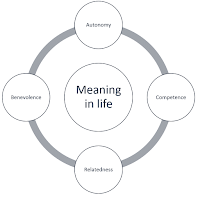
In earlier times the question of how to lead meaningful life was simply answered by referring to the bible (or another religious text, depending on when and where you were born). But for an increasing number of people religious dogma is no longer a satisfying answer to the question what a meaningful life means. Nowadays it has become a common wisdom that we should discover or create meaning in life ourselves. This raises two questions: how important is a sense of having meaning in life anyway, and -if it is important - how can we find or create it?

The Emerging Neuroscience of Intrinsic Motivation

Image
A new paper by Di Domenico & Ryan (2017) describes how a neuroscience of intrinsic motivation is emerging. Intrinsic motivation is the total of our spontaneous tendencies to be curious and interested, to seek challenges, and practice to develop our skills and knowledge even in the absence of separate rewards. Research within the framework of self-determination theory has shown that intrinsic motivation is a motivation which is present throughout the life span and which is associated with various positive effects such as learning, performing, creativity, and well-being. But intrinsic motivation is dependent on the perception of one's own competence and autonomy. If these two basic needs are thwarted, we tend to be less intrinsically motivated.

Is the feeling that you are competent always an indication of incompetence?

Image
In this article I mentioned the following quote by Charles Darwin: "Ignorance more frequently begets confidence than does knowledge." I agreed with this and offered the Dunning-Kruger effect as an explanation of the phenomenon. This explanation, briefly, is that it takes competence to more or less reliably assess one's own competence. People with low competence in a certain area do not realize how low their competence is. In another article I mentioned that incompetence can even go hand in hand with arrogance while competence can go hand in hand with modesty. Of course, the Dunning-Kruger effect is not only applicable to other people but also to ourselves. David Dunning (photo), one of the pioneering researcher into the effect, said the following:

Three basic needs: always operative even when we don't realize it

Image
We use the word 'need' broadly in daily life. It can refer to anything we desire for or think we need or prefer, at any time. In psychology, in particular within self-determination theory (SDT), it has a much more specific meaning. SDT speaks of universal basic needs for autonomy, competence, and relatedness ( read more ). The word 'need' in SDT refers to something that is a requirement for good and healthy functioning.

Self-determination theory in organizations

Image
In a new article Deci et al. (2017) give an overview of research within self-determination theory which is relevant for work and organizations. Among other things, they describe the important distinction between autonomous and controlled motivation (see more about this distinction) and the three basic psychological need (for competence, autonomy, and relatedness). The article reviews much research with as central theme that autonomous motivation (vs controlled motivation) is associated with both performance and wellness. Also, the show that the key to fostering autonomous motivation is to create workplaces which contribute to the satisfaction of the above mentioned basic needs. The picture below summarizes these points:

10 Questions to help you fulfill your basic needs

Image
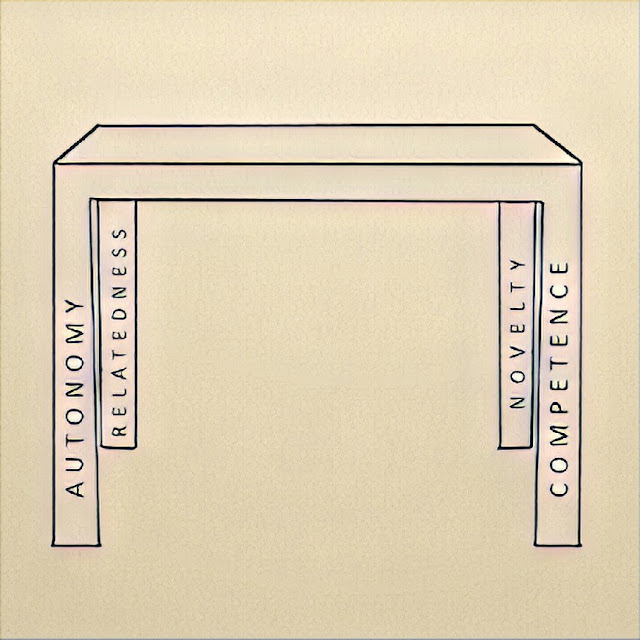
Self-determination theory distinguishes three universal basic psychological needs, the need for autonomy, for competence, and for relatedness. The fulfillment of these needs is necessary for us to feel well and function well. The need for autonomy refers to the experience of being able to make your own choices and to stand behind what you are doing. The need for competence refers to the experience of being effective and capable of achieving desired outcomes. The need for relatedness refers to the experience of a mutual connection with and care for important people your life. Recent research by González-Cutre et al. (2016 ) indicates there may be a fourth basic need: the need for novelty, the need to keep on experiencing new things which deviate from your daily routine.

Which types of goals when?

Image
There are different types of goals. What are the differences and when does which type of goal work best? In a new article, Latham & Seijts (2016) summarize the findings of goals-setting theory (GST; Locke & Latham, 1990 ; 2013 ), a well supported theory about how goals work. GST-research has shown that setting specific, challenging goals lead to higher performance than easy and abstract goals. The general rule is that higher goals lead to higher performance providing four conditions have been met: the individual is competent for the goals, has sufficient situational resources, is committed and receives objective feedback on goal progress.

3 Ways in which self-assessment may demotivate

Image
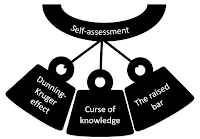
How you look at your own progress determines how competent and motivated you will feel. A way of working which is not well-suited for this, is to grade your own competence level. There are at least three reasons why this type of self-assement is slippery and unreliable: (1) the Dunning-Kruger effect, (2) the curse of knowledge, and (3) the raised bar.

Equality bias (making the Dunning-Kruger effect worse)

Image
Frequent readers of this website know the Dunning-Kruger effect ( Kruger & Dunning, 1999 ). Briefly put this effects says: incompetent people do not know how incompetent they are. The reason for this is that in order to be able to know how competent you are at something you need to have knowledge about that competence domain. People who know very little about a topic do not realize how much there is to know about that topic and therefore how much competence they lack. The Dunning-Kruger effect means that people who are not so competent at something are inclined to overestimate their own competence. This phenomenon is sometimes referred to as confident ignorance.

How do you get goals that work?

Image
Self concordant goals, goals that fit with your interests and values have many advantages. How do you get them? It is not only important that people set goals but also what types of goals they set. Within Self-Determination Theory the term self concordant goals has been introduced. Self concordant goals are goals which are consistent with the developing interests and values of the individual. When goals are self concordant people fully endorse these goals. They are autonomously motivated to pursue them.

What is meaningful work?

Image
As Teresa Amabile and Steven Kramer have shown, making progress in work that is meaningful is one of the most motivating, if not the most motivating, things in work. Even small progress may have a big positive impact on one's inner work life (this is the authors' term for perception, emotions and motivations in one's work). 'Meaningful progress', of course, consists of two parts: the meaningful part and the progress part. I have focused a lot on the progress element in many previous posts. I'd now like to focus on the meaningful part.

How progress can make itself invisible

Image
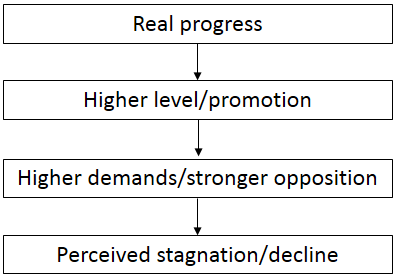
The feeling of making progress in something which is important to you is very motivating. But sometimes you make progress without being aware of it and thus you miss this motivating effect needlessly. In this article I explained some reasons why achieved progress can sometimes be hard to notice. One reason I mentioned is sensory adaptation. This means that we get used to the progress we have made and because of this we stop perceiving it. A second reason I mentioned is that we may interpret progress negatively. An example of this is that we may view the availability of technological resources not as advantages but as perils or problems. A third reason why we may not notice progress is that we may, sometimes unconsciously, concurrently raise the bar for ourselves. When this happens, not only our competence level has increased but also the level we aim for. Because of this, the distance between our current level and our goal remains the same (or even increases).

Combining practice based learning and theory based learning

Image
As mentioned before on this site, I am rather reluctant about the usefulness of a giving advice - especially unasked-for advice. In general my assumption is that self-found internal solutions , solutions which are based on people's own experience and which they can apply themselves without help or training by others, are the most motivating way forward in many situations. By the way, from this, it does not follow that we can't help other people. We can actually help people identify their own internal solutions. But the way to do this is not to offer them judgments and advices. Instead, through a process of asking carefully chosen questions and interventions people can, in many cases be helped to find their own solutions to problems ( here is an example of how such a helping strategy may be designed).