Posts

Showing posts with the label commitment

Which types of goals when?

Image
There are different types of goals. What are the differences and when does which type of goal work best? In a new article, Latham & Seijts (2016) summarize the findings of goals-setting theory (GST; Locke & Latham, 1990 ; 2013 ), a well supported theory about how goals work. GST-research has shown that setting specific, challenging goals lead to higher performance than easy and abstract goals. The general rule is that higher goals lead to higher performance providing four conditions have been met: the individual is competent for the goals, has sufficient situational resources, is committed and receives objective feedback on goal progress.
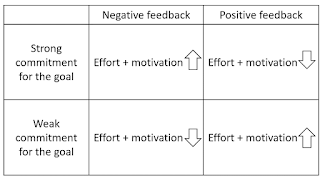
When is positive feedback more motivational and when negative feedback?

Image
Constructive feedback, both negative and positive, can play an important role in goal achievement. Previous research by Koo and Fishbach (2008) demonstrated that feedback can signal two kinds of messages. The first type of message is about commitment: it can say something about whether your goals are valuable and whether you have a good change of achieving them. Individuals which are not strongly committed to a certain goal can become more motivated after receiving positive feedback (and less after receiving negative feedback). The second message is about progress: feedback can say something about whether you have put in enough effort and whether you have achieved enough progress. Strongly committed individuals tend to get more motivated by negative feedback and less motivated by positive feedback (see the figure on the right). By the way, with negative feedback I do not mean personal criticism or blame but constructive information about what is not going well yet and what could b...

Balancing a progress-focus and a commitment-focus

Image
There is much evidence that the world, on the whole, is getting better in many ways (see for instance work by Matt Ridley , Steven Pinker , and Hans Rosling ). In accordance with this view is a new article by  Zack Beauchamp  on Thinkprogress called  5 Reasons why 2013 Was The Best Year In Human History . He presents the following 5 reasons: