Posts

Showing posts with the label classroom

Three findings on growth mindset cultures in organizations and classrooms

Image
Broadly speaking, there are two ways to think about the malleability of our traits and capabilities. When we have a growth mindset , we see traits and abilities as developable. In a fixed mindset we see them as not or hardly capable of development. In addition to individual mindsets, there are also mindset cultures . Researchers Wallace et al. (2023) explored the impacts of these cultures, uncovering three findings about growth mindset cultures in organizations and classrooms.

Autonomy-support in the classroom

Image
George, a high school teacher, looked into the classroom of his colleague Bill and saw, to his amazement, that the students of the class, which had a reputation of being a very difficult class, were quietly working. At lunch break he asked Bill with a surprized smile: "How did you get them to do that, man? I get nothing but trouble from this class. I see no other solution than to get really tough with them. That'll teach them!" Bill smiled and then explained how he used the principle of autonomy-support in his classroom and he said this worked rather well. He explained that this meant, among other things, to provide many choices for students, taking students' feelings and opinions quite seriously, and avoiding controlling language. When he heard that, George said: "That sounds rather naive of you. If you do that they will walk right over you!"

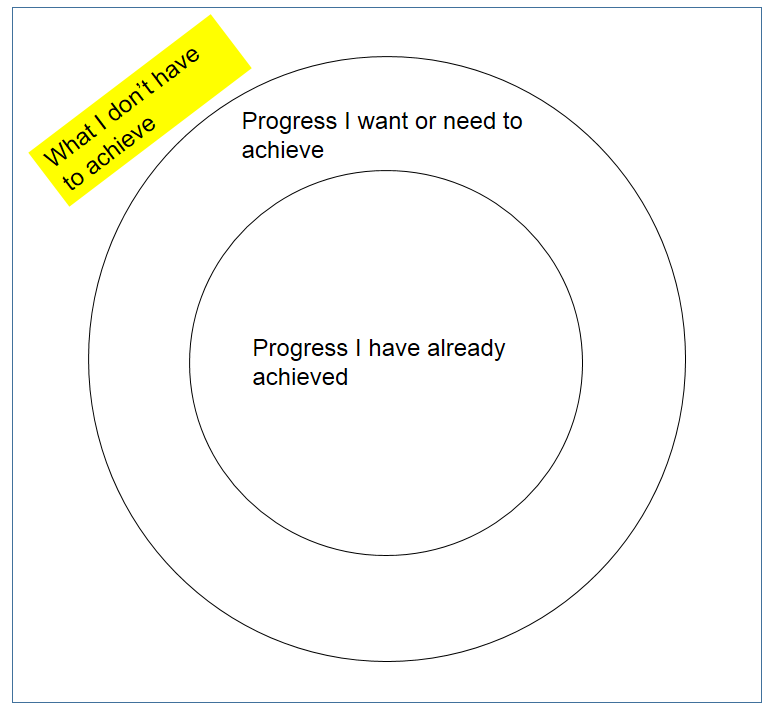
It can also be useful to look at what is outside of the outer circle

Image
The progress-focused circle technique is getting more well-known and popular. It works like this: the coach draws two circles on a piece of paper or on a flip-over sheet, an inner circle and an outer circle. On small post-it notes clients write down what progress they have already achieved and then they hang them in the inner circle. Next, clients write on post-it notes what progress they further need and/or want to achieve and they hang these in the outer circle. Finally, clients choose which note(s) they first want to be able to move from the outer circle to the inner circle and how they will try to accomplish this. On the first day of a training I gave to a group of teachers I explained the circle technique and invited them to experiment a bit with it. I also gave an example of how I had once used the circle technique with a client of mine. What was interesting in that situation was that my client had not only hanged post-it notes in the inner and outer circle but also outside ...