Posts

Showing posts with the label basic needs

Parental autonomy support, basic needs, and self-esteem

Image
Understanding the dynamics between parenting styles and children's psychological development is important. A new study by Chen et al. (2024) examines the relationship between parental autonomy support, basic psychological needs, and the self-esteem of Chinese primary school students. Through an extensive cross-sectional analysis, the study examines how autonomy support influences children's self-image.

Acting on your values ​​leads to feeling and functioning better

Image
In this article , I wrote that self-determination theory research shows that when we engage in activities that are in line with our values, we feel and function better. A reader was interested in this and asked me for literature references showing this. You can read my answer here.

The different effects of the fulfillment and frustration of basic needs

Image
Within self-determination theory , much attention has been devoted for years to the positive effects of supporting basic psychological needs. Somewhat less attention has been paid to the undermining of motivation and functioning through frustration of needs. A new study looks at both.

Meaning in life

Image
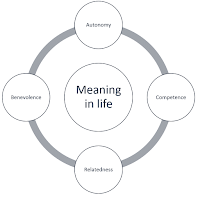
Frank Martela , a Finnish philosopher and psychologist, has written a book entitled A wonderful life. Insights on Finding a Meaningful Existence . In the book he addresses questions such as: "Is life about finding happiness?" and "What can the basis for meaning still be in a time when religion is less and less the self-evident framework?" He invites the reader to think differently about meaning and comes up with some simple ideas for experiencing meaning.

Morality as a basic psychological need

Image
In a new book chapter, researchers Jayawickreme, Prentice & Fleeson (2020) describe preliminary evidence for morality as a basic psychological need . Below I will discuss some parts of this chapter. 

Pure altruism: does it exist?

Image
What does human nature look like? Are humans naturally good or bad? Are we selfish by nature or are we capable of purely selfless (altruistic) action? Are we mainly engaged in a constant battle with each other or is it more correct to say that we mainly work together and take care of each other? How we answer these kinds of questions for ourselves is quite important. Our answers to these questions determine to a large extent what we expect from ourselves and what we expect from others. And as a result, they also determine how we treat others and how we interpret behavior of others.

4 Differences between Maslow's Pyramid and the basic psychological needs from self-determination theory

Image
The " Pyramid of Maslow " is one of the more famous ideas in psychology. Abraham Maslow formulated the basis for this idea in his publications " A Theory of Motivation " (1943) and Motivation and Personality (1954).  In short, this idea implies that people have hierarchically ordered basic needs that are essential for healthy development. This idea has proved intuitively appealing as it has become very popular within and outside of psychology. That it is popular in psychology is shown by the fact that it is hardly missing in any introductory psychology handbook. That it has become popular outside of psychology is shown, among other things, by the fact that a joke in which WiFi has been added as a new basic need to the  Maslow pyramid is immediately understood by almost everyone. It is therefore not surprising that we regularly receive questions about how Maslow's pyramid differs from the now dominant motivation theory within psychology, the self-determination...

How to motivate students? Use a dual process!

Image
The dual process model provides insight into how teachers can support student motivation. Self-determination theory offers important clues for how teachers can improve student motivation. This article provides a summary of these types of interventions. When teachers apply these interventions, students are likely to feel better, become more engaged in lessons and learn and perform better. Jang, Kim & Reeve (2016) show that a two-track approach, or, as they call it, a "dual process model", is needed to achieve this.

The spillover effect and the crucial role of basic needs

Image
Research has shown a correlation exists between how satisfied people are with their job and how satisfied they are with their life. But there are two uncertainties about the relationship between job satisfaction and life satisfaction. First, it is unknown whether this effect primarily happens in the Western world; this is where most of this research has taken place. Second, it is unknown whether there is a causal relationship between job satisfaction and life satisfaction because most research is correlational. Third, there is no clear explanation for the relationship between job satisfaction and life satisfaction. A new paper provides more clarity in all these questions.

Where does meaning in life come from?

Image
In earlier times the question of how to lead meaningful life was simply answered by referring to the bible (or another religious text, depending on when and where you were born). But for an increasing number of people religious dogma is no longer a satisfying answer to the question what a meaningful life means. Nowadays it has become a common wisdom that we should discover or create meaning in life ourselves. This raises two questions: how important is a sense of having meaning in life anyway, and -if it is important - how can we find or create it?

How does grading affect motivation?

Image
Research guided by self-determination theory has shown that factors like punishment, rewards, threats, coercion, and competition can undermine the quality of motivation of individuals. When those factors are applied the autonomous motivation of individuals, which consists of intrinsic motivation and internalized motivation, can be diminished ( read more about autonomous motivation). In such circumstances a more controlled motivation can emerge which generally comes with anxiety, tension, and worse performance. One factor which also can harm autonomous motivation is grading performance in schools. A new study by Krijgsman et al. (2017) explores the relationship between performance grading and students motivation in physical education (N=409).

The Emerging Neuroscience of Intrinsic Motivation

Image
A new paper by Di Domenico & Ryan (2017) describes how a neuroscience of intrinsic motivation is emerging. Intrinsic motivation is the total of our spontaneous tendencies to be curious and interested, to seek challenges, and practice to develop our skills and knowledge even in the absence of separate rewards. Research within the framework of self-determination theory has shown that intrinsic motivation is a motivation which is present throughout the life span and which is associated with various positive effects such as learning, performing, creativity, and well-being. But intrinsic motivation is dependent on the perception of one's own competence and autonomy. If these two basic needs are thwarted, we tend to be less intrinsically motivated.

Intrinsic and extrinsic motivation and goals

Image
The terms intrinsic and extrinsic motivation are frequently used and are sometimes a source of confusion. Below, I try to share my understanding of these term as they are used in self-determination theory (SDT). First, I'll explain what the difference between intrinsic and extrinsic motivation is and  then what the terms intrinsic and extrinsic goals mean.

Three basic needs: always operative even when we don't realize it

Image
We use the word 'need' broadly in daily life. It can refer to anything we desire for or think we need or prefer, at any time. In psychology, in particular within self-determination theory (SDT), it has a much more specific meaning. SDT speaks of universal basic needs for autonomy, competence, and relatedness ( read more ). The word 'need' in SDT refers to something that is a requirement for good and healthy functioning.

10 Questions to help you fulfill your basic needs

Image
Self-determination theory distinguishes three universal basic psychological needs, the need for autonomy, for competence, and for relatedness. The fulfillment of these needs is necessary for us to feel well and function well. The need for autonomy refers to the experience of being able to make your own choices and to stand behind what you are doing. The need for competence refers to the experience of being effective and capable of achieving desired outcomes. The need for relatedness refers to the experience of a mutual connection with and care for important people your life. Recent research by González-Cutre et al. (2016 ) indicates there may be a fourth basic need: the need for novelty, the need to keep on experiencing new things which deviate from your daily routine.

Should we make happiness the focus of our lives?

How important should we consider being happy? Should it be a general goal in our life to be happy? Or should it perhaps even be the ultimate goal we should have as a person? Must we see happiness as the main goal in many or all domains of our life, such as work and education? While happiness as a goal sounds quite important, perhaps we should not conclude too quickly that our life resolves or should revolve around happiness only. What happiness precisely is, how we achieve it, and to what extent we should focus on it, may harder to answer that you might think.

Satisfaction of basic psychological needs predicts choosing mastery goals

Image
In this article I described research which shows that choosing mastery goals predicts intrinsic motivation. Based on that research I concluded that it is wise for parents and teachers to encourage students to choose mastery goals (vs. performance goals). A new study by Duchesne et al. (2016) suggests an effective way to do this. That way is: create the conditions in which the  basic psychological needs (of autonomy, competence, and relatedness) of students are satisfied.

Is need for novelty the fourth basic psychological need?

Image
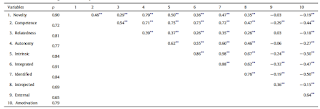
We may need to keep on experiencing new things in order to keep on functioning well and feeling well.  Self-determination theory has identified three basic, innate psychological needs - the need for autonomy, competence, and relatedness - which need to be fulfilled for optimal functioning. In a paper by González-Cutre et al. (2016) preliminary evidence is provided that need for novelty is also a basic psychological need contributing to optimal functioning. In two studies, participants completed a new measure to assess novelty need satisfaction, the Novelty Need Satisfaction Scale (NNSS), measures of psychological needs and regulation styles and psychological well-being.

Working in solitude on very ambitious goals

Image
New research suggests how people may work in solitude on very ambitious goals and feel good about it.  Some famous artists and scientists from the past must have set extraordinary ambitious goals for themselves and must have worked for extremely long periods of time in solitude on their work and discoveries. For example, it is known that Isaac Newton, generally viewed as one of the greatest scientific geniuses of all time, who was highly productive as well, spend many years working in relative solitude. I have sometimes wondered how such people have managed to accomplish such things and to what extent they experienced gratification about their life style. I came across two articles by Thuy-vy Nguyen which give a clue about how some people are able to lead and bear such lives.

8 Principles in progress-focused change

Image
Progress-focused principles and techniques are not only useful in individual conversations and team facilitation processes but also in facilitating organizational change. Here are a few principles I propose for organizational change. Share decision making / work as participatively as possible: change is acceptable when people feel that they can (at least partly) influence or even determine what the change is and how it is shaped.