Posts

Showing posts with the label Deliberate practice

Confirmation of the importance of deliberate practice in the development of excellence

Image
For the past ten years or so, deliberate practice has become quite well known (although many are more familiar with Malcolm Gladwell's incorrect interpretation of it as the 10,000 Hours Rule ). As can be read in popular publications (such as the book Peak ), deliberate practice is a form of practice that plays an important role in building excellence. But in recent years, a number of publications have appeared (such as Macnamara, 2014) that suggest that deliberate practice plays a less important role than previous research showed. Anders Ericsson, p ioneer in research into deliberate practice, along with Kyle Harwell, responds to the recent criticisms in recent paper.

Who was Anders Ericsson?

Image
On June 17, 2020, psychologist Anders Ericsson unexpectedly passed away at the age of 72 in Florida, where he lived and worked. He is considered by many to be the world's most influential researcher in the field of expertise development and elite performance. His colleague Neil Charness wrote : “Yes, he was and is a superstar. He shone so brightly, illuminating our field, blazing new paths, lighting the way for so many students and colleagues. He will be sorely missed, but his work will endure. ” Who was this influential psychologist?

Checklist: 7 questions to support your professional development

Image
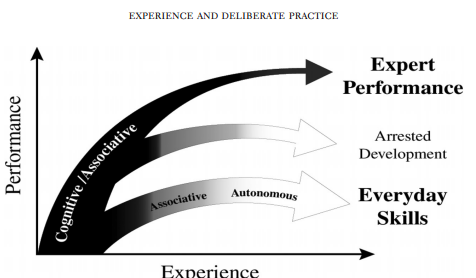
What role does experience play in our professional development? We often think that how long people have been doing something determines how good they are at it. Of course, that thought can't be completely wrong. We can't say that there is no relationship at all between how long you have been doing something and how good you are at it. Someone who has been playing the piano for just a few weeks can't be very good at it yet. Learning the basic skills requires a certain time. But the relation between how long we have been doing something and how good we are at it is different than we often assume. Take as an example driving a car. When both my sons were doing their driving lessons, these last few years, they could precisely point out to me the many little mistakes I made while driving. I have been doing it for 35 years and thought I was reasonably good at it. But because of the many small reprimands by my sons, I have come to realize that many little mistakes have crept int...

Intrinsic and extrinsic motivation and goals

Image
The terms intrinsic and extrinsic motivation are frequently used and are sometimes a source of confusion. Below, I try to share my understanding of these term as they are used in self-determination theory (SDT). First, I'll explain what the difference between intrinsic and extrinsic motivation is and  then what the terms intrinsic and extrinsic goals mean.

The vital role of frustration in deliberate practice

Image
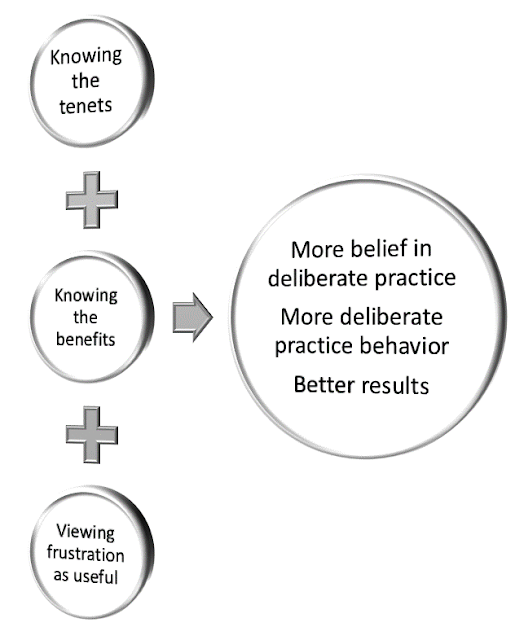
I received many responses to my article How we can keep on breaking through performance ceilings . Most were positive, some where constructively critical. Most were about the claim that stretching one's abilities comes with a certain discomfort and frustration. One person asked whether this frustration or discomfort is really necessary. Another person asked whether this frustration does not contradict the progress principle which says that experiencing meaningful progress is very motivational ("how can experiencing frustration ever be motivational?").

How to motivate students for deliberate practice

Image
Top performers in all kinds of disciplines use the power of deliberate practice. They practice in a goal-focused way on challenging tasks, get immediate feedback and keep repeating until mistakes disappear from their performance. By doing this for many years, they keep breaking through performance limits and keep making progress. But deliberate practice does not only work for those who want to reach the top of their discipline. The approach works at witch ever level you happen to be. Unfortunately, many people fail to use and benefit from deliberate practice. In a new research project Eskreis-Winkler et al. (2016) have looked at how students can be motivated to use deliberate practice and how this impacted their performance.

How we can keep on breaking through performance ceilings

Image
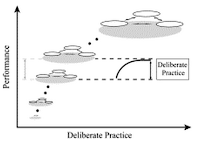
Deliberate practice is a way of practicing which is very challenging yet very effective. Many studies have shown that prolonged deliberate practice plays an important role in the achievement of excellence in all kinds of disciplines. Deliberate practice has four basic characteristics: (1) goal-focus: individuals have clear goals of improving specific parts of their performance, (2) challenge: while practicing individuals constantly try something which is just above their current skill level, (3) feedback: while practicing, individuals get immediate expertise-based feedback, and (4) repetition: individuals repeat tasks until mistakes in their performance have been eliminated.

Discomfort as a sign that you are learning

Image
About eight years ago my colleague Gwenda Schlundt Bodien and I did a big evaluation of our training courses. We wanted to find out what worked and what didn't in our courses. We send an e-mail to all participants who had attended our courses in the past years. We asked them to complete a brief survey in which we asked them which parts of our courses they had found most useful. On the list were items like: PowerPoint presentations, group discussions, video observations, practicing with other participants, practicing with the trainers, practicing with live clients, analyzing written dialogues, plenary discussion and explanations, reflecting team exercises, etc.

3 Dimensions of studying effectively

Image
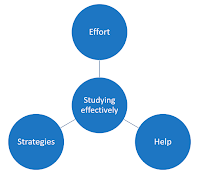
How can we study effectively? Below, I describe three dimensions of studying effectively. These are not only meant for young people in schools or universities. Nowadays, lifelong learning has become normal. Keeping on learning and studying is healthy for us. Keeping on challenging ourselves cognitively is one factor contributing to a healthy life. Knowing how to study effectively is beneficial for anyone at any age. The tips below can be used for studying from books but also for other purposes, for example for learning to play a musical instrument.

Deliberate practice is also important for creative achievement

Image
Scott Barry Kaufman wrote an article in which he asserted that deliberate practice may be important in achievement domains such as chess and playing a musical instrument but that it does not work as well for almost any creative domain. His argument is: deliberate practice works well for activities which rely on consistently replicable behaviors that must be repeated over and over again but this is not what creative performance relies on. In a response to Kaufman's article, The deliberate creative , Cal Newport refutes Kaufman's assertion convincingly.

Interview with Anders Ericsson

Image
K. Anders Ericsson is a Swedish psychologist who is a professor at Florida State University. In the beginning of his career he worked with among other Nobel laureate Herbert Simon. He is recognized as the most prominent researcher in the area of expertise development. Together with his colleagues, he has done research into how experts in different areas have managed to reach the top of their fields. Uptil now he has mostly scientific publications. But now he and Robert Pool have published a popular book about expertise development: Secrets from the New Science of Expertise . Here is an interview with Ericsson about this new book. 

Macnamara et al (2014) meta-analysis on deliberate practice not convincing

Image
Recently, Macnamara et al. (2014) published a meta-analysis that, they claimed, showed that "deliberate practice is important, but not as important as has been argued" by Ericsson et al. (1993) . Previously, I have written about earlier critical publications about Ericsson's work. Then, I thought these publications, in several ways, did not do justice to his work ( read this ). One of the authors of this new meta-analysis (Hambrick) was one of the authors whose publication I was critical of then. Now, I was curious whether this new publication would do justice to Ericsson and to the deliberate practice concept. Unfortunately, I don't think it does.

Anders Ericsson responds to criticisms

Image
Why expert performance is special and cannot be extrapolated from studies of performance in the general population: A response to criticisms K. Anders Ericsson Abstract : Many misunderstandings about the expert-performance approach can be attributed to its unique methodology and theoretical concepts. This approach was established with case studies of the acquisition of expert memory with detailed experimental analysis of the mediating mechanisms. In contrast the traditional individual difference approach starts with the assumption of underlying general latent factors of cognitive ability and personality that correlate with performance across levels of acquired skill. My review rejects the assumption that data on large samples of beginners can be extrapolated to samples of elite and expert performers. Once we can agree on the criteria for reproducible objective expert performance and acceptable methodologies for collecting valid data, I believe that scientists will recognize the n...

Do recent publications prove Anders Ericsson and colleagues wrong about the importance of deliberate practice? No.

Image
About deliberate practice I have written much about deliberate practice . Researchers have demonstrated there is a lack of evidence for the claim that natural ability is the main factor behind top performance. They have found out that what is crucial instead is the amount of time the individual has practiced and the specific way in which he or she has practiced (read more about deliberate practice here and here ). Recently, two articles were published on the relative importance of deliberate practice and 'talent' for achieving high levels of performance. First, there was Deliberate Practice Is Necessary but Not Sufficient to Explain Individual Differences in Piano Sight-Reading Skill by E. Meinz and D. Hambrick. Second, there was  Deliberate Practice: Necessary But Not Sufficient   by G. Campitelli and F. Gobet. Do these articles shed a new light on how important deliberate practice is? Do they call for a return to the idea that innate abilities are, in the e...