Posts

Showing posts matching the search for dunning

How the Dunning-Kruger effect can block progress

Image
A brief way of explaining the Dunning-Kruger effect is that it takes competence to recognize incompetence. A consequence of this is that people who are relatively incompetent are less able to recognize their own incompetence. Kruger & Dunning (1999) and Dunning et al. (2003) showed that in incompetent people there is often a self-overestimation effect: people with low performance tend to overestimate their own performance. The lower the performance, the higher the self-overestimation tends to be. The higher the performance the less people tend to overestimate themselves. The very highest performing people even tend to underestimate themselves. This phenomenon creates the painful situation that those who perform the lowest tend to underestimate their need for development the most. A new study by Pennycook et al. (2017) adds new depth to these previous findings.

Equality bias (making the Dunning-Kruger effect worse)

Image
Frequent readers of this website know the Dunning-Kruger effect ( Kruger & Dunning, 1999 ). Briefly put this effects says: incompetent people do not know how incompetent they are. The reason for this is that in order to be able to know how competent you are at something you need to have knowledge about that competence domain. People who know very little about a topic do not realize how much there is to know about that topic and therefore how much competence they lack. The Dunning-Kruger effect means that people who are not so competent at something are inclined to overestimate their own competence. This phenomenon is sometimes referred to as confident ignorance.

The Dunning-Kruger effect: Why does it happen? Why is it so tricky?

Image
The assessment of one's own knowledge and skills is an important skill. Unfortunately, it is not easy to accurately assess yourself. This is reflected, among other things, in the Dunning-Kruger effect (DKE). In this article I discuss a study by Rachel Jansen and her colleagues into two possible explanations for the DKE. I also explain why the DKE is so tricky and why we intuitively tend to think that especially others are vulnerable to it.

Is the feeling that you are competent always an indication of incompetence?

Image
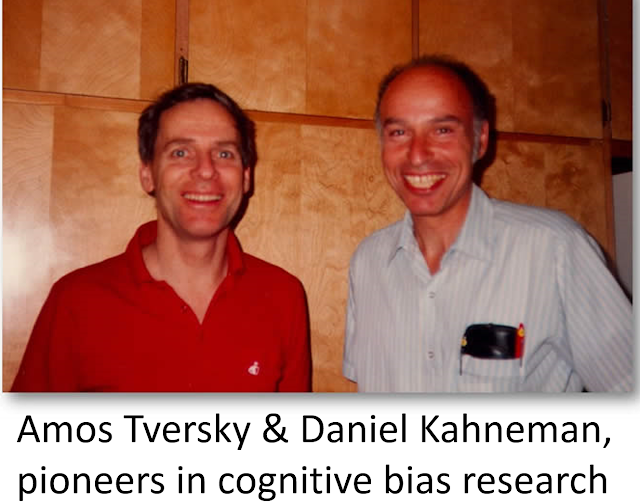
In this article I mentioned the following quote by Charles Darwin: "Ignorance more frequently begets confidence than does knowledge." I agreed with this and offered the Dunning-Kruger effect as an explanation of the phenomenon. This explanation, briefly, is that it takes competence to more or less reliably assess one's own competence. People with low competence in a certain area do not realize how low their competence is. In another article I mentioned that incompetence can even go hand in hand with arrogance while competence can go hand in hand with modesty. Of course, the Dunning-Kruger effect is not only applicable to other people but also to ourselves. David Dunning (photo), one of the pioneering researcher into the effect, said the following:

The Dunning-Kruger ramp

Image
The Dunning-Kruger effect is the phenomenon that people who are incompetent in a certain area often are not aware -and cannot be aware- of just how incompetent they are. A explanation of this counter intuitive effect is the following: when you know little about a subject you do not know how much knowledge you are lacking due to which you are likely to overestimate yourself.

The growth mindset goes hand in hand with an awareness of our own limitedness

Image
An unrealistic and harmful belief which I have written about a lot is the fixed mindset ( Dweck, 2006 ). In a fixed mindset we believe that certain capabilities and traits cannot be developed. Due to this belief we do not put in effort and we do indeed not get better. A growth mindset is more realistic and works better. In a growth mindset we believe that abilities can grow and characteristics can change. This way of thinking inspires us to do our best and increases our chances of making progress. At the same time, a growth mindset goes hand in hand with a clear awareness of our own limitedness. How is that possible?

3 Ways in which self-assessment may demotivate

Image
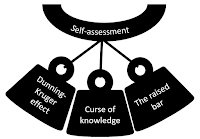
How you look at your own progress determines how competent and motivated you will feel. A way of working which is not well-suited for this, is to grade your own competence level. There are at least three reasons why this type of self-assement is slippery and unreliable: (1) the Dunning-Kruger effect, (2) the curse of knowledge, and (3) the raised bar.

How to deal with the arrogant-yet-ignorant state of mind

Image
We do not fully perceive and understand reality as it is. First, our senses do not permit us to perceive large parts of reality accurately or at all. Second, evolution has equipped us with cognitive rules of thumb (heuristics) which are fast and helpful to survive in most situations but which are also crude and inaccurate in many ways ( read more ). To add to this, we are to some (perhaps large) extent unaware of these handicaps. In other words, we may be ignorant without realizing it. The 2x2 model below describes four states of mind regarding our own ignorance.

23 Cognitive biases, heuristics and effects

Image
One of the ways we can counter irrational beliefs is by informing ourselves about some well documented cognitive biases, heuristics and effects which all to some extent skew are perception of reality, usually without us being aware of it. I'll keep my explanations brief because it is quite easy to learn more about each of these biases, heuristics and effects by googling them.

Overconfidence and the fixed mindset

Image
Research has shown that many people tend to overestimate their own capabilities. This overconfidence may undermine performance and relationships with other people. This tendency of people to be overconfident is often thought to be universal. New research, however, shows that this is not the case. It shows that people with a fixed mindset are more vulnerable to overconfidence.

When is positive feedback more motivational and when negative feedback?

Image
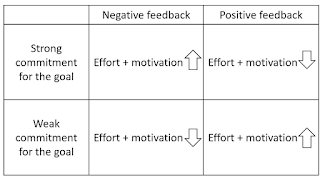
Constructive feedback, both negative and positive, can play an important role in goal achievement. Previous research by Koo and Fishbach (2008) demonstrated that feedback can signal two kinds of messages. The first type of message is about commitment: it can say something about whether your goals are valuable and whether you have a good change of achieving them. Individuals which are not strongly committed to a certain goal can become more motivated after receiving positive feedback (and less after receiving negative feedback). The second message is about progress: feedback can say something about whether you have put in enough effort and whether you have achieved enough progress. Strongly committed individuals tend to get more motivated by negative feedback and less motivated by positive feedback (see the figure on the right). By the way, with negative feedback I do not mean personal criticism or blame but constructive information about what is not going well yet and what could b...