Posts

A national experiment reveals where a growth mindset improves achievement

By Yeager et al. (2019) Abstract : A global priority for the behavioural sciences is to develop cost-effective, scalable interventions that could improve the academic outcomes of adolescents at a population level, but no such interventions have so far been evaluated in a population-generalizable sample. Here we show that a short (less than one hour), online growth mindset intervention— which teaches that intellectual abilities can be developed—improved grades among lower-achieving students and increased overall enrolment to advanced mathematics courses in a nationally representative sample of students in secondary education in the United States. Notably, the study identified school contexts that sustained the effects of the growth mindset intervention: the intervention changed grades when peer norms aligned with the messages of the intervention. Confidence in the conclusions of this study comes from independent data collection and processing, preregistration of analyses, and corrobor...

Meta-analyses of positive psychology interventions: The effects are much smaller than previously reported

Carmela A. White, Bob Uttl, Mark D. Holder (2019) Abstract For at least four decades, researchers have studied the effectiveness of interventions designed to increase well-being. These interventions have become known as positive psychology interventions (PPIs). Two highly cited meta-analyses examined the effectiveness of PPIs on well-being and depression: Sin and Lyubomirsky (2009) and Bolier et al. (2013). Sin and Lyubomirsky reported larger effects of PPIs on well-being (r = .29) and depression (r = .31) than Bolier et al. reported for subjective well-being (r = .17), psychological wellbeing (r = .10), and depression (r = .11). A detailed examination of the two meta-analyses reveals that the authors employed different approaches, used different inclusion and exclusion criteria, analyzed different sets of studies, described their methods with insufficient detail to compare them clearly, and did not report or properly account for significant small sample size bias.

22 Quotes from People, Power and Profits by Joseph Stiglitz

Image
Nobel prize winner economist Joseph Stiglitz has written a new book called People, Power and Profits . In this book he describes how, since the mid-1970s has been dominated by a conservative ideology which, step-by-step has brought every increasing inequality and the undermining of democracy. In the book, Stiglitz explains what's wrong and what's needed and how to move forward.

Reducing Violence in Non-controlling Ways: A Change Program Based on Self Determination Theory

This paper presents and examines the first school change program focusing on violence and caring based on self-determination theory (Deci & Ryan,2012). The program aimed at promoting teachers’ capacity to cope with violence and enhance caring without becoming more controlling.Comparisons of the effects of a 22-month-long program in three intervention schools and three control schools indicated that the program (a) reduced violent student behavior and controlling teacher behavior and (b) enhanced caring student behavior and active teacher response to violence. The results suggest that exposure to self-determination theory (SDT) concepts may promote a firm, yet non-controlling, teacher response to violence. More generally, the results highlight the potential for incorporating SDT ideas in violence reduction programs. Read full article here .

How can we determine whether or not to believe something?

Image

Critical analysis by Sisk et al. (2018) - two meta-analyzes on mindsets

Image
Some time ago, a paper was published describing two meta-analyzes on the effects of mindsets and mindset interventions ( Sisk et al., 2018 ). The authors conclude that the results in both analyzes were weak and that education is better able to spend its time and money on other things than on mindset interventions. They do, however, make the nuance that their research suggests that mindset interventions do seem worthwhile for special risk groups. However, there is quite a lot to haggle on the article. Not only on their findings, but, more importantly, on their interpretation of those findings. Read below why even the problematic article by Sisk et al. actually shows that mindset interventions are indeed interesting and important.

Communicating effectively with people with dementia

Image
Last week, a participant in one of our courses brought in a case for intervision . His case was that he had recently found out that his mother, who lived quite far away from him, had dementia. He wanted to get some tips from the other participants about how he could deal as effectively as possible with this challenging situation. What he hoped to find was a way of dealing with the situation in which he could help his mother as much as possible while also keeping on taking good care of himself. During the exercise he received many compliments and tips. The exercise was both useful to him and to the other participants.

Progress-focused intervision: fast and useful

Image
Progress-focused intervision can help teams to reflect on a case and to get some good ideas for progress within about 20 minutes. One person presents a case and the rest of the team are in a helping role. The approach has some rules and steps which I will describe below. It usually works best if the rules and steps are followed rather closely and if the process proceeds rather quickly. After all the steps have been taken there is no further discussion of the case.

Why I think the blockchain will bring progress

Image
Recently, I have become interested in a new technology which is gaining popularity and which will probably have a great impact on our society: the blockchain. Put simply, blockchain technology is a technological infrastructure underlying cryptocurrencies like  Bitcoin . Below I will explain a bit the emergence of this new technology, about what it is, and about why it will probably become very important.

The motivation continuum: self-determination theory in one picture

Image
Elements from self-determination theory are somewhat known to many people. Particularly, the terms intrinsic motivation and extrinsic motivation are familiar to many people. Also reasonably well-known are the basic psychological needs of autonomy, competence, and relatedness. Recently someone said to me: "I have heard of several elements of the theory but I find it hard to get a good overview of the it." If you feel the same, the picture below may be useful for you. It is my most recent version of the so-called motivation-continuum. There are many version of this model in circulation and they are all variations on and extension of the original version by Ryan & Deci (2000) . In the picture below I show which types of motivation emerge in which contexts, and what their effects are on our behaviors, emotions, and performance (click to enlarge).

Carol Dweck's new theory on the foundations of personality

Image
Carol Dweck, founder of mindset theory, has written an ambitious new paper in Psychological Review . In this paper, she presents a new theory about how personality is formed and how both nature and nurture play a role in this. The interesting thing about this theory is that it both establishes connections between old and new theories within psychology and that is brings together separate psychological disciplines. Social psychologists have often been criticized for paying too little attention to theory building and for merely developing fragmentary knowledge. Dweck now comes up with a strong answer to these criticisms in the form of a broad theory which may turn out to explain a broad range of psychological phenomena. This type of theorizing is not only important for social scientists but also for practitioners for whom psychological knowledge is relevant (and who is really excluded from this group?). Good theory can help practitioners deal with problems in more informed, systematic ...

Is there a good case for 'positive education'?

Image
In this post I expressed my skepticism about something which is called Positive education , an approach advocated by Martin Seligman (photo). What that is, is explained in this video which I also mentioned. My two reasons for being skeptical were 1) that I found the definitions of positive education as mentioned in the video confusing rather than clarifying, and 2) that it is not clear to me to what extent well-being should be an outcome measure in education ( read the post for more details on that point).

Are positive stereotypes taken as compliments?

We generally think of stereotypes as generalizing negative judgments about a category of people. In a stereotype the behavior of individuals is attributed to the group to which they (appear to) belong. Also, supposed negative characteristics of groups may be projected on individuals which belong to the group. It is not surprising that many people view stereotypes as undesirable. There are some quite dangerous sides to it. They can create tensions between groups and even undermine the integrity of society. Moreover they deny the unique character of individuals. But what about positive stereotypes, in other words, positive generalizations about social groups? Will these be viewed positively because they are really just complimentary?

The punitive versus the empathetic mindset

Image
Some time ago, I heard about a situation in which a student behaved disruptively in class. I will repeat here, from memory, what happened. The teacher asked the student if he would calmly join the lesson and pay attention. The student did not directly reply and went on with his disruptive behavior. Then some other students started making comments like: "Just send him to the hall, miss." The teacher replied: "No, I will not send him to the hall", to which the students said: "Why not? He is behaving very badly." The teacher replied: "If I send students to the hall, they will not learn how to behave appropriately in the classroom. That is why I won't do that." Then she repeated here question to the student to calmly pay attention to the lesson which he then started to do without complaining. This approach seems counter-intuitive. Shouldn't you just be tough to students behaving badly? Maybe not. A new paper provides some insight into what ...

The spillover effect and the crucial role of basic needs

Image
Research has shown a correlation exists between how satisfied people are with their job and how satisfied they are with their life. But there are two uncertainties about the relationship between job satisfaction and life satisfaction. First, it is unknown whether this effect primarily happens in the Western world; this is where most of this research has taken place. Second, it is unknown whether there is a causal relationship between job satisfaction and life satisfaction because most research is correlational. Third, there is no clear explanation for the relationship between job satisfaction and life satisfaction. A new paper provides more clarity in all these questions.

Where does meaning in life come from?

Image
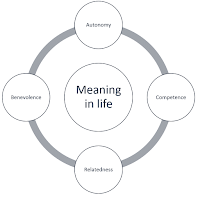
In earlier times the question of how to lead meaningful life was simply answered by referring to the bible (or another religious text, depending on when and where you were born). But for an increasing number of people religious dogma is no longer a satisfying answer to the question what a meaningful life means. Nowadays it has become a common wisdom that we should discover or create meaning in life ourselves. This raises two questions: how important is a sense of having meaning in life anyway, and -if it is important - how can we find or create it?

The learning and performing model

Image
After I wrote this post I talked to several people about the importance of making the distinction between learning and performing. Most people I talked to found this distinction interesting and valuable and were interested in the three phases I mention: the preparation phase, the execution phase, and the reflection phase. Generally, people found these stages useful and they said they would like to pay more attention to preparation and reflection.

Why do we bounce back from failure better when we have a growth mindset?

Image
We know that we generally bounce back from failure better when we have a growth mindset than when we have a fixed mindset (Dweck, 1999). This has to do with the fact that we interpret failing differently in different mindsets and because of that we also feel and behave differently. In a growth mindset we view failure as a consequence of not having put in enough effort or not having used an effective strategy ( read more ).

The effects of envy and admiration

Image
You meet someone who is obviously better at something than you are. What do you feel? Do you admire the person? Do you feel envy? What are the effects of these different emotions? Below you can first read about social comparison theory, which has something useful to say about these phenomena. Then, I mention new research by Niels van de Ven about the effects of these different emotions.

The growth mindset and intrinsic motivation contribute independently to persistence

Image
One way to describe what the progress-focused approach means is captured in a model which I introduced in my book Kiezen voor progressie . The model (see figure right) describes how both a growth mindset and autonomous motivation contribute to effective effort and how effort in turn creates progress. In this post you read more about this model and it may be used. Looking at this model you might wonder if there should also be an arrow between the growth mindset and autonomous motivation. Do these two influence each other, too? I have thought this before and several people have asked me about it. As far as I know it has been studied only once.

How does grading affect motivation?

Image
Research guided by self-determination theory has shown that factors like punishment, rewards, threats, coercion, and competition can undermine the quality of motivation of individuals. When those factors are applied the autonomous motivation of individuals, which consists of intrinsic motivation and internalized motivation, can be diminished ( read more about autonomous motivation). In such circumstances a more controlled motivation can emerge which generally comes with anxiety, tension, and worse performance. One factor which also can harm autonomous motivation is grading performance in schools. A new study by Krijgsman et al. (2017) explores the relationship between performance grading and students motivation in physical education (N=409).

The Emerging Neuroscience of Intrinsic Motivation

Image
A new paper by Di Domenico & Ryan (2017) describes how a neuroscience of intrinsic motivation is emerging. Intrinsic motivation is the total of our spontaneous tendencies to be curious and interested, to seek challenges, and practice to develop our skills and knowledge even in the absence of separate rewards. Research within the framework of self-determination theory has shown that intrinsic motivation is a motivation which is present throughout the life span and which is associated with various positive effects such as learning, performing, creativity, and well-being. But intrinsic motivation is dependent on the perception of one's own competence and autonomy. If these two basic needs are thwarted, we tend to be less intrinsically motivated.

The problem with twin studies

Image
Over roughly the last 100 years there has been a debate within the social sciences about the question how large the influence of genes and environments are on human abilities, traits, behaviors, and psychiatric and medical problems. This debate is often referred to as the nature versus nurture debate. It is not only held within the scientific community but also in popular media and by lay people. A central role in these debates is played by the so-called twin studies. Often these studies are viewed as compelling natural experiments which demonstrate the separate influence of genes and environmental factors. And they are often cited as evidence of the large influence of genes on personal characteristics such as intelligence and personality traits. But there is a growing criticism of the validity of these conclusions because there are many problems in those twin studies. A recent book by Joseph (2015) explains in detail what the many problems in twin studies are.

Checklist: 7 questions to support your professional development

Image
What role does experience play in our professional development? We often think that how long people have been doing something determines how good they are at it. Of course, that thought can't be completely wrong. We can't say that there is no relationship at all between how long you have been doing something and how good you are at it. Someone who has been playing the piano for just a few weeks can't be very good at it yet. Learning the basic skills requires a certain time. But the relation between how long we have been doing something and how good we are at it is different than we often assume. Take as an example driving a car. When both my sons were doing their driving lessons, these last few years, they could precisely point out to me the many little mistakes I made while driving. I have been doing it for 35 years and thought I was reasonably good at it. But because of the many small reprimands by my sons, I have come to realize that many little mistakes have crept int...

How teachers can combine autonomy-support with structure

Image
Autonomy support is effective in parenting, in teaching, and in leadership at work. Some incorrectly think that a remark like this should be read as a plea for 'anything goes'. Autonomy support does not mean that no structure is offered. Autonomy support and structure go hand in hand. Offering structure strengthens the perception of autonomy and is even often a prerequisite for it. I elaborate this thought using the context of education as an example.