Posts

Showing posts with the label study

Breaks as Performance Boosters: New Insights

Image
The quest for productivity at work often leads to the idea that working more equals better results. This perspective, supplemented with anecdotes about CEOs who wake up early and work weekends, dominates the popular literature. But what if the key to both wellness and performance actually lies in taking breaks? This line of thinking was explored in a systematic review of more than 80 studies on taking breaks in the workplace, conducted by  Lyubykh & Gulseren (2023) .

The punitive versus the empathetic mindset

Image
Some time ago, I heard about a situation in which a student behaved disruptively in class. I will repeat here, from memory, what happened. The teacher asked the student if he would calmly join the lesson and pay attention. The student did not directly reply and went on with his disruptive behavior. Then some other students started making comments like: "Just send him to the hall, miss." The teacher replied: "No, I will not send him to the hall", to which the students said: "Why not? He is behaving very badly." The teacher replied: "If I send students to the hall, they will not learn how to behave appropriately in the classroom. That is why I won't do that." Then she repeated here question to the student to calmly pay attention to the lesson which he then started to do without complaining. This approach seems counter-intuitive. Shouldn't you just be tough to students behaving badly? Maybe not. A new paper provides some insight into what ...

The social contagiousness of mindsets

Image
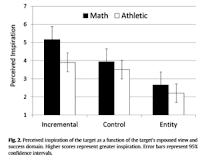
All of us are constantly exposed to all kinds of stimuli from our environment which affect how we feel and how we think about ourselves and about the world. An example of how we are affected is our mindset. Some events, remarks, and expectations that come our way evoke a fixed mindset in us while others evoke a growth mindset. The prime example of this is the differential effect of different types of praise.

What is the relation between mastery goals and intrinsic motivation?

Image
Bieg et al. (2016) did a study to clarify the relation between mastery goals and intrinsic motivation. Let's first look at what these two concepts mean. Meaning and importance of mastery goals and intrinsic motivation Mastery goals are focused on developing competence. This is in contrast with performance goals which are focused on demonstrating one's competence in comparison with others. Why are mastery goals important? Because research has shown that they have many positive effects (in comparison with performance goals), such as choosing challenging goals, persistence, more interest, deeper learning, etc. Intrinsic motivation is the desire to do things which are inherently interesting, fun, exciting or otherwise satisfying. Intrinsic motivation is not only fun. It is also important because it is associated with positive emotions, interest, and deep learning.

How To Study

Image
Guest post by Jamie Hale  The effort required to form strong memory is often intense for students. Students often spend hours trying to master new information. Of course, methods to enhance memory are important for everyone, not just students. For example, when a friend recommends a new shoe store we want to remember the name of of it, or when going to the grocery it is important to remember the items we need to pick up. What are some strategies that can be used to strengthen memory?

The Progress Principle

Image
Coert Visser, Juli 1, 2012 In 2011, Teresa Amabile, a professor of Business Administration at Harvard Business School and Steven Kramer, a developmental psychologist published the book The Progress Principle: Using Small Wins to Ignite Joy, Engagement, and Creativity at Work which is one of the most compelling cases yet for focusing on progress in work. In the book they report on a large scale study into worker performance and motivation. One thing Amabile and Kramer did was to survey more than 600 managers from dozens of companies, asking them to rank the impact on employee motivation and emotions of five workplace factors: recognition for good work, incentives, interpersonal support, making progress and clear goals. The majority of these managers, chose “recognition for good work”. But a multiyear study which tracked day-to-day activities of 238 people in 26 project teams in 7 companies in 3 industries showed that these managers were not right about this. The study exami...

Correcting harmful work behavior

Image
There is an interesting new working paper by two Harvard Business School researchers: Toxic workers (Housman & Miner, 2015). They analyzed a large data set containing a range of information about more than 50,000 workers from 11 firms. Their analyses were aimed at gaining insight into which personal and situational circumstances lead to toxic behavior and into which effects toxic behaviors have. In the working paper they present some interesting findings and they make some recommendations for management and HR-policy. Below, I will briefly summarize the findings and add some personal remarks.

Mental effort can be contagious

Image
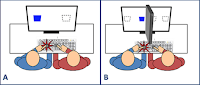
In what they do, people are sensitive to the presence of others. But what is exactly known about the influence of other people's presence? The social facilitation effect has been known since 1965 and means that people perform behaviors which are largely automated more easily in the presence of others. But the presence of others can be distracting when executing tasks which require much concentration ( Horwitz & McCaffrey, 2008 ). In a new study Desender, Beurms, & Van den Bussche (2015) demonstrate that mental effort can be contagious.

How to decrease the harmful effects of negative team relationships

Image
What can you do to decrease the harmful effects of a negative team atmosphere?   A negative team atmosphere and negative relationships between team members can harm both employees' job satisfaction and team performance. Researchers De Jong et al. (2014) compared three different ways of dealing with such problems. They called the first approach communication density with which they meant that team members had frequent contact with one another and tried to improve the atmosphere. The second approach which was called member exchange referred to team members assisting one another, and giving help and feedback to one another when needed.

How different types of motives affect performance and growth

Image
Amy Wrzesniewski and Barry Schwartz have written an opinion piece in the New York Times about effective motivation ( read here ). In the piece they distinguish two types of motivation: internal motivation and instrumental motivation. These terms correspond two other terms which are more well-known in the psychological literature. Internal motivation corresponds to autonomous motivation; instrumental motivation corresponds to controlled motivation. They did a study to examine how these two types of motivation affected performance ( Wrzesniewski  et al (2014 ).

Using social network incentives to stimulate engagement, trust and results

Image
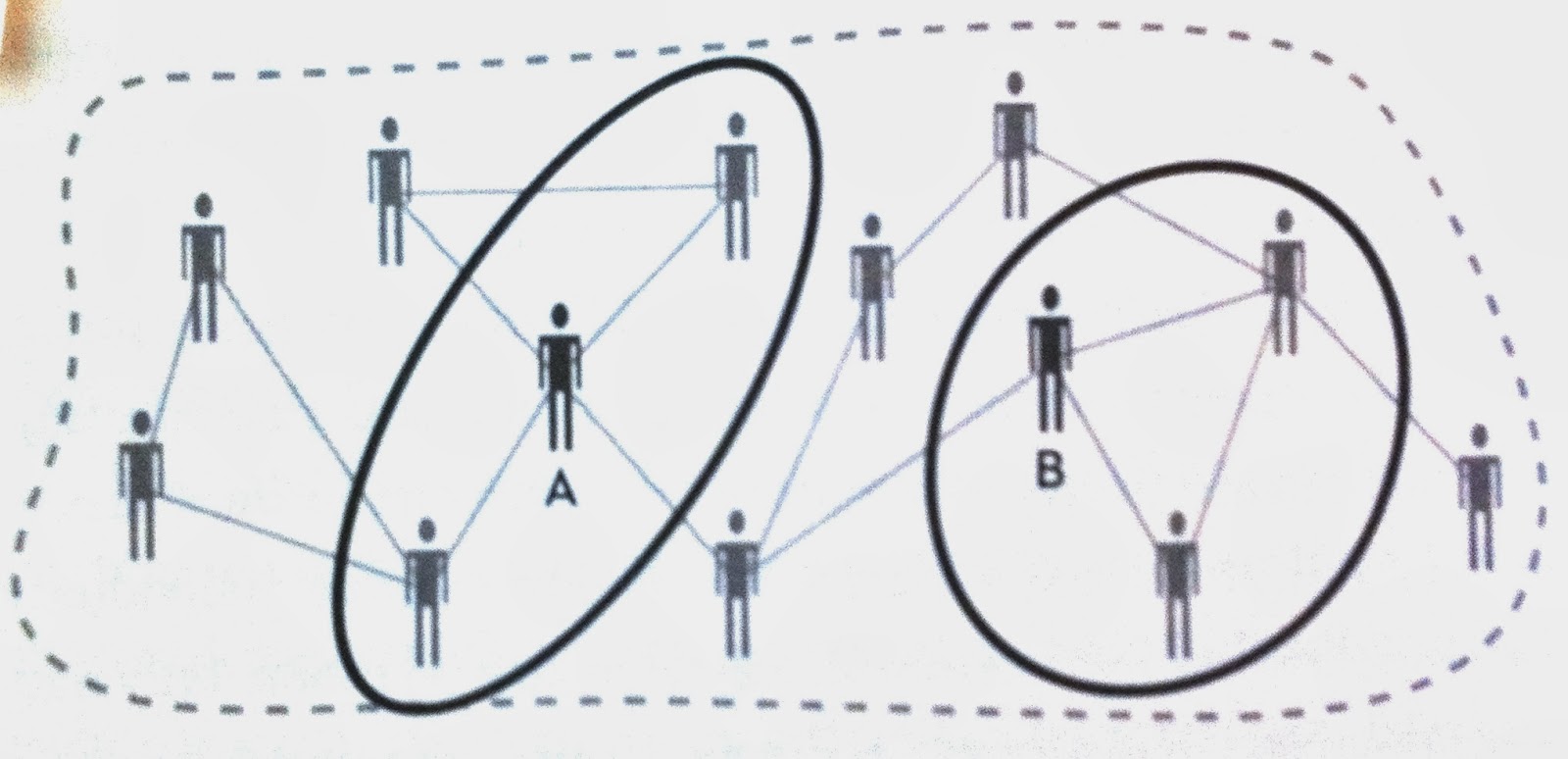
In this article I mentioned Alex Pentland's book Social Physics . One of the points frequently made in the book is that engagement , direct strong, positive interactions between people, within work groups is very important. By repeatedly interacting in cooperative manners, trust grows between team members and common beliefs, habits and norms emerge.