Posts

Showing posts with the label reason

8 Autonomy-Supportive Practices for Raising Toddlers

Image
Autonomy support is useful in many contexts such as leadership, teaching, and parenting. Research provides indications that autonomy support by parents contributes to children functioning well, developing well and feeling good. A study by Andreadakis et al. (2019) examines how parents can provide autonomy support to toddlers in situations where toddlers need to do things that are important but not interesting to them, such as cleaning up, taking a bath, washing hands, etc.


The leftward drift

Image
I came across an intriguing bit in Richard Nisbett's book Mindware which was about what he called the leftward drift. This leftward drift refers to the fact that the number of college and university students who self-identify as liberal or far left in their political orientation increase as they move through college. At the same time, the number of students who call themselves conservative or far left decreases. In other words, college makes many students drift to the left in their political views.

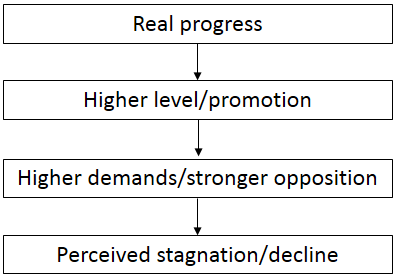
The harder we push, the worse it gets

Image
Parents, teachers, and managers play an important role for respectively children, students, and employees. They not only have a facilitating, helping role but also a directing role. They pay attention, show understanding, they help and facilitate, they give a good example and they clarify expectations and set limits. When they fulfill their role effectively, the individuals they work with will be likely to function and develop well en feel good. These individuals are likely to engage in what they find interesting and important and to behave in well-adjusted ways and offer useful contributions.

When to interrupt?

Image
In progress-focused conversations you will not often interrupt your conversation partner. Sometimes, however, you will deliberately interrupt. Here, I explain when and how you may do that.  As a rule, progress-focused coaches and managers do not interrupt their conversation partners during conversations. They ask questions, listen attentively, encourage, and respond respectfully to what is said. Because of this, their conversation partners will feel that their perspective is taken seriously and that they have time to think calmly about what is important to them.

How progress can make itself invisible

Image
The feeling of making progress in something which is important to you is very motivating. But sometimes you make progress without being aware of it and thus you miss this motivating effect needlessly. In this article I explained some reasons why achieved progress can sometimes be hard to notice. One reason I mentioned is sensory adaptation. This means that we get used to the progress we have made and because of this we stop perceiving it. A second reason I mentioned is that we may interpret progress negatively. An example of this is that we may view the availability of technological resources not as advantages but as perils or problems. A third reason why we may not notice progress is that we may, sometimes unconsciously, concurrently raise the bar for ourselves. When this happens, not only our competence level has increased but also the level we aim for. Because of this, the distance between our current level and our goal remains the same (or even increases).