Posts

Showing posts with the label negativity bias

The influence of self-selection and the negativity bias on intergroup contact

Image
The negativity bias influences how contact between groups reinforces prejudices and ideas about other groups. This has long been researched by psychologists. Previous research suggests that positive intergroup contact can reduce prejudice. However, a recent meta-analysis by Paolini et al. (2024) points to a more complex picture. This is especially true when people can choose whether they have contact with others. I discuss this meta-analysis below. The researchers looked at the role of negative and positive experiences in intergroup contact. They also looked at the influence of self-selection and the impact of negativity bias.

How do you deal with someone who is very negative?

Image
During a recent training that we gave to managers, we discussed research by Teresa Amabile on inner work experience. One of the implications of Amabile's research is that, as a manager, it is wise to try to limit negativity in your own communications. When we addressed this, one participant asked, “But how do you deal with someone else who is very negative?” This question is understandable and provides a valuable opportunity to reflect on the topic of negativity.

Progress monitoring: countermeasure against the negativity bias

Image
Progress monitoring can be a powerful countermeasure to the negativity bias . We almost always start our training sessions with a start up exercise. This is a short exercise, usually about 10 minutes, that we usually do in pairs. During the exercise, we always give the participants a concrete question to discuss. A question that is regularly used is: “Take turns telling each other about meaningful progress you have made in the past period.” I often remain surprised at how well this question works and how beneficial it is.

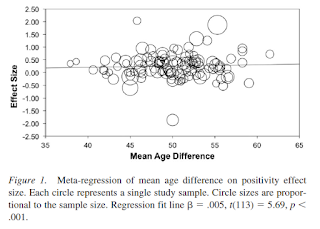
Good is Stronger than Bad for Older People: The Age-Related Positivity Effect

Image
Fifteen years ago, in a review article entitled Bad is stronger than good , Baumeister et al. (2001) documented research into the so-called negativity bias. The article cites research showing that negative events, emotions, and information impact us more strongly than positive ones do. They conclude their article by saying: "In our review, we have found bad to be stronger than good in a disappointingly relentless pattern. We hope that this article may stimulate researchers to search for and identify exceptions; that is, spheres or circumstances in which good events outweigh bad ones. Given the large number of patterns in which bad outweighs good, however, any reversals are likely to remain as mere exceptions."