Posts

Showing posts with the label book review

Review of Against Empathy – Paul Bloom (2016)
Image
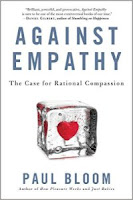
Ideas in psychology can be rather at odds with our intuitions. An example of this can be found in a new book, Against Empathy: The Case for Rational Compassion , written by Paul Bloom, psychologist at Yale University. Many people view empathy as an important source of all that is good in the world and the lack of empathy as an important cause of many bad things in the world.  Leaders like Barack Obama and scientists like George Lakoff and Simon Baron-Cohen view empathy as something of which people can't have too much. Bloom has a different view.

Review of The Big Picture (Sean Carrol, 2016)

Image
I learned about Sean Carroll, theoretical physicist at Caltech, through various interesting YouTube videos on topics such as the non-existence of an afterlife , theism versus naturalism , the arrow of time , the relation between the laws of nature and the meaning of life . Elaborating on that latter theme, Sean Carroll has written an extremely ambitious new book called The Big Picture, On the Origins of Life, Meaning, and The Universe itself in which he, as the title suggests, presents a view on everything trying to integrate what scientists have discovered about cosmology and particle science with a view on meaning of life and morality.

Review of Leadership BS by Jeffrey Pfeffer

Image
I have read many of Jeffrey Pfeffer's books and was looking forward to his new book Leadership BS: fixing workplaces and careers one truth at a time. Unfortunately, I think it is a disappointing book.  Stanford University professor Jeffrey Pfeffer has a provocative new book called Leadership BS: Fixing Workplaces and Careers One Truth at a Time . In the book he criticizes the leadership training industry which, he says, teaches that leaders should be trustworthy, authentic, serving, modest, and empathetic. But according to Pfeffer, there is no evidence that this leadership training does any good. In fact, he says it is harmful because it paints a much too idealistic picture of organizational reality and of the reality of leadership.

Review of Mindware: tools for smart thinking by Richard Nisbett

Image
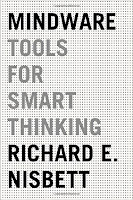
Psychologist Richard Nisbett has written a new book called Mindware: tools for smart thinking. I think it is essential reading for students of psychology. Here is my review. As a psychology student in the 1980s I first learned about the work of the Richard Nisbett. Together with Lee Ross (who coined the term fundamental attribution error; which I will come back to later) he wrote the classic book Human Inference (1980) about how people use rules of thumb in social judgment and decision making and about how we often systematic mistakes in the way we judge events and people. Nisbett & Ross' work build on and was closely related to the work done by Amos Tversky and Daniel Kahneman.

The Marshmallow Test by Walter Mischel

Image
Walter Mischel is a 84 year old professor at Columbia University. He is the author of a fascinating new book called The Marshmallow test . Mischel became known at the end of the 1960s, mainly through his publications about two topics. The first topic was the degree to which situations influence human behavior. He did research which showed that the idea that people have stable personality traits which cause us to behave consistently over many situations is largely a myth. Instead, he demonstrated, we tend to behave quite differently in different contexts. Thus, characteristics of situations have a significant influence on how we behave. The second topic was self-control. Together with colleagues he did much research into the causes and consequences of self-control, in particular with regard to how children manage to delay gratification. The series of experiments which these researchers did have become know under the popular name of the Marshmallow test , hence the book title.

r>g

Image
Thomas Piketty, author of Capital in the Twenty-First Century Until 2010, I did not know much about the consequences of economic inequality. Then I came across the book The Spirit Level in which the authors Richard Wilkinson and Kate Pickett presented their research results which showed that high levels of inequality in societies is harmful for everyone within them. Their research showed that (1) the more developed a country is, the less important further economic growth is for certain objectively measurable outcomes, like life expectancy ( see graph ), (2) in a study of 23 of the richest countries there was a strong relationship between health and social problems and the level of income inequality ( see graph ), (3) in a study of the 50 American States this same relationship was found ( see graph ).

The Cult of Statistical Significance

Image
There is a new book called The Cult of Statistical Significance by Stephen T. Ziliak and Deirdre N. McCloskey which seems to be an important one to me. The book shows how many scientific disciplines rely way too much on the concept of statistical significance. I have read the book and I find it convincing. The authors show how the focus on statistical significance has taken away attention for 'real' significance. In other words: the focus on statistical significance often means that researchers fail to ask whether their findings matter. In statistics, a result is called statistically significant if it is unlikely to have occurred by chance. So testing for statistical significance is asking the question how likely it is that an effect exists. It tries to answer that question by looking at how precisely the effect can be measured. It does not answer at all how strong and important this effect is. And this latter question about the effect size is much more important from a sc...