Posts

Showing posts with the label ability

The intelligent attitude

Image
What is the intelligent attitude? Psychologists have been measuring intelligence for over 100 years. Intelligence measurements have been widely used for years for admission to educations and selection decisions. In a new article, Robert Sternberg (2022) argues for a broader view of intelligence. I discuss some of the main points from the interesting article.

The social contagiousness of mindsets

Image
All of us are constantly exposed to all kinds of stimuli from our environment which affect how we feel and how we think about ourselves and about the world. An example of how we are affected is our mindset. Some events, remarks, and expectations that come our way evoke a fixed mindset in us while others evoke a growth mindset. The prime example of this is the differential effect of different types of praise.

8 Growth mindset interventions

Image
Many of the participants in our training programs are especially interested in Carol Dweck's research into mindsets . They see the relevance of mindset and realize that a fixed mindset has many disadvantages while a growth mindset has many advantages. They are interested in learning how they can influence their own mindset and that of other people. Many of them are aware that person praise can evoke a fixed mindset and process praise can evoke a growth mindset. But they look for other way to influence mindsets. Here are several other ways.

The naturalness bias - operating implicitly and across domains and costly

Image
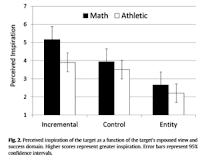
What do we value more in other people's performance: hard work or talent? And what does it matter what the answer is to this question? The naturalness bias in music appreciation Researchers Tsay & Banaji (2011) found evidence for a naturalness bias which is the tendency to prefer supposed 'naturals' over 'strivers'. Even though expert musicians stated that they found hard work more important than talent they implicitly preferred talent over hard work. Tsay and Banaji demonstrated this by presenting more than 100 professionally trained musicians with two profiles of two professional musicians, and a sample musical clip to listen to from each musician.

Carol Dweck's theory tested and largely supported

Image
Carol Dweck's mindset theory has now been fully tested by Smiley et a. (2016) . To understand how they did this, I'll first try to summarize Dweck's theory (see picture below which is mine but was inspired by Smiley et al.'s paper). What Dweck's theory predicts

Should teachers focus on performance differences between students or within students?

Image
Teachers’ perceptions and actions can have a great impact on students’ beliefs, motivation, effort and performance. One way in which teachers affect their students is in the way they evaluate students’ performance. Falko Rheinberg (1980) showed that some teachers tend to compare students with each other – this is called a social reference norm orientation (social RNO) – while other teachers tend to compare a student’s current learning outcomes with his or her previous performance – this is called an individual reference norm orientation (individual RNO).