Posts

Showing posts with the label Teresa Amabile

Asking for Feedback as a Manager

Image
A manager in our training said that he was going to ask employees for feedback. It was about the following topic. Research by Teresa Amabile and Steven Kramer shows that a positive inner work experience has to do with how positively you feel about your work, how good you feel at work, and that you have the feeling that your work matters. This work experience largely determines how well you function, also as managers. We gave our managers a checklist with examples of actions they could take to increase the positive inner work experience of their employees. We also gave the checklist examples of actions that undermine employees’ inner work experience and that they should therefore avoid.


The cruelty incentive: judging negatively to appear intelligent

Image
We live in a time of great changes in our societies. Organizations must continue to innovate to succeed in a changing society, which requires leaders and managers to foster a culture that fosters creativity and innovation and to continue to explore new ways to innovate and grow. If innovation is also important in your organization, it can be useful to take note of the cruelty incentive .

Interruptions reduce the quality of your work

Image
Several authors have advocated blocking time during you workday for working uninterruptedly. Amabile & Kramer (2011) say, on the basis of their research, that this is a condition for making progress in what is meaningful to you. Newport (2016) claims that working long and focused without interruptions leads to a dramatic increase in productivity and work satisfaction. Research by Sophie Leroy has shown that when you pick up a task again after an interruption there will be what she calls an attention residue. This means that part of your mental energy is still focused on what you were doing during the interruption. The interruption harms your deep focus.

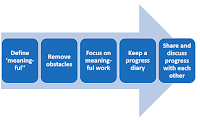
5 steps to harness the progress principle

Image
Coert Visser, September 6, 2013 In their large-scale study, Teresa Amabile and Steven Kramer have discovered that making progress in meaningful work is a main contributor to a positive work life and to good performance (Read more about this study, here ). Here are a few practical suggestions to harness the power of meaningful progress.

Remove obstacles

Image
Coert Visser, September 9, 2013 Making progress in meaningful work is one of the most motivating factors for employees. Therefore, it is important to talk about and to describe desired and achieved progress, frequently. But did you know that negative occurrences such as setbacks and failures can have a 2 to 3 times stronger (negative) effect on motivation than positive factors? This was shown in a study by Amabile and Kramer .

The Progress Principle

Image
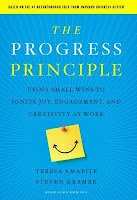
Coert Visser, Juli 1, 2012 In 2011, Teresa Amabile, a professor of Business Administration at Harvard Business School and Steven Kramer, a developmental psychologist published the book The Progress Principle: Using Small Wins to Ignite Joy, Engagement, and Creativity at Work which is one of the most compelling cases yet for focusing on progress in work. In the book they report on a large scale study into worker performance and motivation. One thing Amabile and Kramer did was to survey more than 600 managers from dozens of companies, asking them to rank the impact on employee motivation and emotions of five workplace factors: recognition for good work, incentives, interpersonal support, making progress and clear goals. The majority of these managers, chose “recognition for good work”. But a multiyear study which tracked day-to-day activities of 238 people in 26 project teams in 7 companies in 3 industries showed that these managers were not right about this. The study exami...