Posts

Showing posts with the label Talent

How we can keep on breaking through performance ceilings

Image
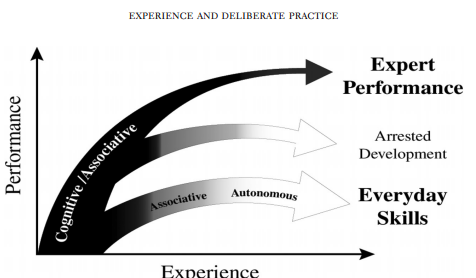
Deliberate practice is a way of practicing which is very challenging yet very effective. Many studies have shown that prolonged deliberate practice plays an important role in the achievement of excellence in all kinds of disciplines. Deliberate practice has four basic characteristics: (1) goal-focus: individuals have clear goals of improving specific parts of their performance, (2) challenge: while practicing individuals constantly try something which is just above their current skill level, (3) feedback: while practicing, individuals get immediate expertise-based feedback, and (4) repetition: individuals repeat tasks until mistakes in their performance have been eliminated.

The naturalness bias - operating implicitly and across domains and costly

Image
What do we value more in other people's performance: hard work or talent? And what does it matter what the answer is to this question? The naturalness bias in music appreciation Researchers Tsay & Banaji (2011) found evidence for a naturalness bias which is the tendency to prefer supposed 'naturals' over 'strivers'. Even though expert musicians stated that they found hard work more important than talent they implicitly preferred talent over hard work. Tsay and Banaji demonstrated this by presenting more than 100 professionally trained musicians with two profiles of two professional musicians, and a sample musical clip to listen to from each musician.

Macnamara et al (2014) meta-analysis on deliberate practice not convincing

Image
Recently, Macnamara et al. (2014) published a meta-analysis that, they claimed, showed that "deliberate practice is important, but not as important as has been argued" by Ericsson et al. (1993) . Previously, I have written about earlier critical publications about Ericsson's work. Then, I thought these publications, in several ways, did not do justice to his work ( read this ). One of the authors of this new meta-analysis (Hambrick) was one of the authors whose publication I was critical of then. Now, I was curious whether this new publication would do justice to Ericsson and to the deliberate practice concept. Unfortunately, I don't think it does.

Do recent publications prove Anders Ericsson and colleagues wrong about the importance of deliberate practice? No.

Image
About deliberate practice I have written much about deliberate practice . Researchers have demonstrated there is a lack of evidence for the claim that natural ability is the main factor behind top performance. They have found out that what is crucial instead is the amount of time the individual has practiced and the specific way in which he or she has practiced (read more about deliberate practice here and here ). Recently, two articles were published on the relative importance of deliberate practice and 'talent' for achieving high levels of performance. First, there was Deliberate Practice Is Necessary but Not Sufficient to Explain Individual Differences in Piano Sight-Reading Skill by E. Meinz and D. Hambrick. Second, there was  Deliberate Practice: Necessary But Not Sufficient   by G. Campitelli and F. Gobet. Do these articles shed a new light on how important deliberate practice is? Do they call for a return to the idea that innate abilities are, in the e...