Posts

Showing posts with the label David Yeager

David Yeager's book '10 to 25′ about the mentor mindset

Image
Recently, the book 10 to 25: The Science of Motivating Young People was published by David Yeager, an American professor of psychology. In this book, Yeager introduces the concept of the mentor mindset , an approach that combines high expectations and empathic support to effectively understand and support young people in the crucial life phase from 10 to 25 years old.


The synergistic mindsets intervention

Image
In this article I describe new research by David Yeager and his colleagues into how mindsets about abilities and mindsets about stress can reinforce each other, in a positive and negative sense.

Interview with Greg Walton

Image
- Coert Visser  Gregory M. Walton , associate professor of psychology at Stanford University, does research and teaching focused on wise interventions which target psychological processes involved in individual and major social problems. These wise interventions may shift how people think about themselves and their situations and may help them flourish, even over long periods of time. Recently he co-edited, with Alia Crum , the Handbook of Wise Interventions. How Social Psychology Can Help People Change . We talk about what these wise interventions are. Why use the word ‘wise’ to describe them? What are some examples of these interventions? How can it be that these brief and simple interventions sometimes have such long term benefits? 

Answers to four critical questions about the growth mindset

Image
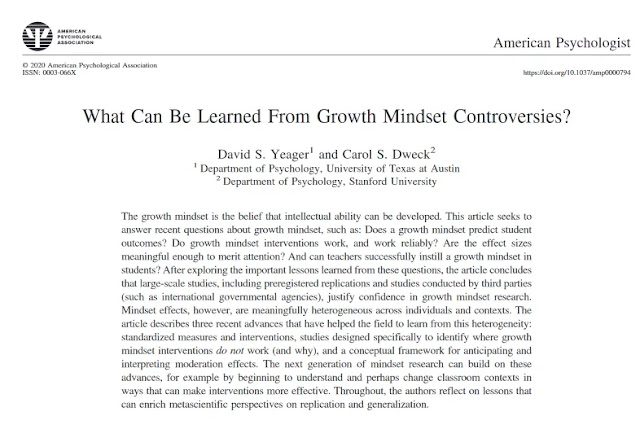
The growth mindset is the belief that personal characteristics such as intellectual abilities can be developed through effort and strategy. David Yeager and Carol Dweck have written an article which addresses four critical questions about the growth mindset:  Does a growth mindset predict student outcomes?  Do growth mindset interventions work and do they work reliably?  Are the effect sizes meaningful enough to merit attention?  Can teachers successfully be taught a growth mindset and instill a growth mindset in their students?  Below I summarize the article without going into all the finer points and arguments in the original article. Think of my summary as an introduction to the article and do read the article itself to get the details behind the arguments and conclusions of the authors. 

Unmaskers unmasked? A different perspective on replication studies

Image
A paper by Bryan, Yeager & O'Brien (2019) sheds a new light on the replication crisis in psychology. An image that has emerged here and there of original authors as tinkering cheats and replicators as holy defenders of scientific morality must be revised. Replicators often take too many liberties, both in the design of their research and in the way in which they analyze data.

Paradigm Shift in Social Science: The Heterogeneity Revolution

Image
A new essay by Elizabeth Tipton, Christopher Bryan and David Yeager describes a paradigm shift within the social sciences that is underway that they call the heterogeneity revolution.

Critical analysis by Sisk et al. (2018) - two meta-analyzes on mindsets

Image
Some time ago, a paper was published describing two meta-analyzes on the effects of mindsets and mindset interventions ( Sisk et al., 2018 ). The authors conclude that the results in both analyzes were weak and that education is better able to spend its time and money on other things than on mindset interventions. They do, however, make the nuance that their research suggests that mindset interventions do seem worthwhile for special risk groups. However, there is quite a lot to haggle on the article. Not only on their findings, but, more importantly, on their interpretation of those findings. Read below why even the problematic article by Sisk et al. actually shows that mindset interventions are indeed interesting and important.

Mindset also affects social development

Image
In a new paper David Yeager (2017) explores the possible relation between mindset and problem behavior of adolescents. He describes how, in reaction to social problems such as being bullied or excluded, a fixed mindset (the belief that people cannot change) may lead to self-blame and other-blame and also may predict more extreme affective, physiological, and behavioral responses such as depression and aggression.