Posts

Showing posts with the label Growth Mindset

A growth mindset about the world breaks the illusion of powerlessness

Image
Many people feel powerless in the face of big problems like climate change. This sense of powerlessness can prevent them from taking action, because they think their individual efforts make little difference. Recent research by Jankowski, Mlynski, and Job (2024) offers new insights. It discusses how our beliefs about the changeability of the world—a “ growth mindset about the world ”—play a crucial role in breaking through the illusion of powerlessness .

The Dynamic Self: Growth, Authenticity, Empathy, and Self-Coaching

Image
“I need to control myself.” This simple statement raises a profound question: Who is the “I” that needs to control, and what is the “myself” that needs to be controlled? How can someone be one and the same, yet appear to be made up of many different parts? This confusion shows up not only in language, but also in our thinking about the self. Think of terms like “self-coaching” or “self-compassion.” Who is coaching whom? Who is showing compassion, and to whom? This raises the question: What is the true self? In this article, we’ll look at three key theories that help us better understand the self: mindset theory, self-determination theory (SDT), and Douglas Hofstadter’s idea of ​​the self as a “strange loop.” 

The interplay between growth mindset and autonomous motivation

Image
Two concepts are central to the progress-focused approach : the growth mindset and autonomous motivation. These theories form important pillars of our approach, which is aimed at sustainable effort and meaningful progress. But do growth mindset and autonomous motivation have anything to do with each other? Don't the concepts come from very different research schools? The answer is yes, they are definitely related. In this article, I look at some studies that show there is an interesting interplay between growth mindset and autonomous motivation.

Growth mindset: less cognitive fusion and negative information bias

Image
A new study by Zhao et al. (2024) provides insight into the benefits of a growth mindset. The study examines how a growth mindset can contribute to greater mental resilience and adaptability. This specifically examines the role of cognitive fusion and negative information bias.

Microclimates in the classroom: Goal structures and teacher mindsets

Image
Recent research ( Woznicki et al., 2023 ) examines the formation of classroom microclimates within STEM courses. This study looked at how course goal structures and instructor mindsets contribute to these microclimates and their impact on student perceptions and experiences.

The Role of Mindset and Motivation in the Academic Performance of First-Year Secondary School Students

Image
A recent study ( Boncquet et al., 2023 ) investigated the influence of mindset and motivation on the academic performance of first-year secondary school students (N=3415). This study focused on the quality of motivation according to self-determination theory and the mindset about intelligence following Carol Dweck's framework. The goal was to reveal the impact on learning outcomes such as engagement, learning strategies, and performance.

3 Misunderstandings about the growth mindset cleared up

Image
In a short 2016 article by Carol Dweck in the Harvard Business Review, she discusses some misunderstandings about the growth mindset. The article also contains a short animation. Below you can read the three misconceptions that Carol Dweck discusses in the article. I will provide a brief comment for each misconception.

Growth mindset in education: good for students and teachers

Image
The mindset theory was developed by the famous psychologist Carol Dweck . The growth mindset is a way of thinking where individuals believe that their intelligence, knowledge and skills can be developed through hard work, dedication and perseverance. People with a growth mindset are open to challenges and feedback, and see mistakes as opportunities to learn and grow. In contrast to this is the fixed mindset , in which people believe that their qualities are fixed and cannot be changed.

Growth mindset and reducing inequality in education

Image
Cameron Hecht and colleagues have written an article about the importance of cultivating a growth mindset for reducing inequality in education. It provides an up-to-date insight into what growth mindset researchers are currently focusing on. Here are some key points from the article.

5 Ways in which mindset is relevant to health care professionals

Image
In this article I explain why the growth mindset is an important pillar of the progress-focused approach . Next, I describe five ways in which the growth mindset is relevant to health care professionals.

3 Tips for teachers for promoting a growth mindset

Image
Dave Paunesku, former student of Carol Dweck, is now the director of PERTS, an applied research center at Stanford University. Among other things, he was involved in large-scale research at the Khan Academy. Below I describe three simple tips from Dave Paunesku on how to show a growth mindset to your students and support them in developing a growth mindset themselves.

Answers to four critical questions about the growth mindset

Image
The growth mindset is the belief that personal characteristics such as intellectual abilities can be developed through effort and strategy. David Yeager and Carol Dweck have written an article which addresses four critical questions about the growth mindset:  Does a growth mindset predict student outcomes?  Do growth mindset interventions work and do they work reliably?  Are the effect sizes meaningful enough to merit attention?  Can teachers successfully be taught a growth mindset and instill a growth mindset in their students?  Below I summarize the article without going into all the finer points and arguments in the original article. Think of my summary as an introduction to the article and do read the article itself to get the details behind the arguments and conclusions of the authors. 

10 Growth mindset suggestions during the Coronacrisis

Image
The Coronacrisis is challenging for almost everyone and therefore particularly a period that requires a growth mindset.

A growth mindset tempers the adverse effects of poverty on academic achievement

Image
Socioeconomic background is an important predictor of academic performance. The extent to which this is so varies by country but generally the following is true: people from lower socioeconomic backgrounds tend to perform less well in school than those from higher socioeconomic backgrounds. This is due to, among other things, the following factors: the lower the socioeconomic background of a people is, the more likely it is that they will face certain extra obstacles such as reduced access to educational resources, higher levels of stress, poorer nutrition, and reduced access to healthcare.

Growth mindset intervention improves stress response of adolescents

Image
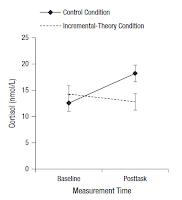
Adolescents are often exposed to negative social judgments. This can create stress when they feel they cannot meet the expectations of a social situation. Yeager et al. (2016) studied whether adolescents would be able to better deal with these challenges when they were taught that people have the potential to learn the required social characteristics. In other words, when they were taught a growth mindset with respect to personality.

What is a growth mindset not?

Image
Perhaps a growth mindset sounds attractive. But perhaps it also sounds to good to be true. Therefore, let's have a look at what a growth mindset is and what it is not. Briefly put, a growth mindset is the belief that you can change your abilities though the investment of effective effort. People do not simply either have a growth mindset or a fixed mindset. Mindset is not like a switch with just two modes: fixed or growth. Instead, there are many degrees possible. It is better to think of mindset as a continuum than as a switch. Furthermore, mindset can be subject to fluctuations. Influences from our environment continuously act on how we think about the malleability of our abilities. In addition to that, it is normal to have different mindsets with respect to different topics. We may believe that we are able to develop certain abilities but may never improve other abilities.

The limiting effects of implicit self-beliefs

Image
Our beliefs about ourselves can have a strong impact on how we behave and on how we develop and flourish. We are not always aware of our self-beliefs. There are what we call implicit self-beliefs. An example of such an implicit self-belief might be: "I am not a math person." Researchers Cvencek et al. (2015) of the University of Washington found, in a study with 299 Singaporean elementary-school students that children of this age often already have such implicit beliefs about whether they are or aren't 'math people'.

Activating a student

Image
I came across a beautiful example of activating a student in a progress-focused manner.  Tina teaches high school students in a special boarding school. During the brief period (usually several months) in which these students are at the boarding school they work independently on their subjects most of the time and whenever they need some help or explanation Tina and their colleagues provide it to them. Of course, every now and then the students also have to take tests. Tina frequently uses progress-focused principles and techniques such as growth mindset interventions and autonomy supportive interventions. Every day, she writes brief observation/reflection diary entries, both for her own purpose and to inform her colleagues about what happened on that day. I have read and remembered one of the recent entries in that diary. I went something like this.

How we can age vitally

Image
The knowledge about how we can age vitally grows. Of course, this is not completely under our control but we can increase its chance.  In my book Progressiegericht werken  I conjecture that we can make meaningful progress into old age. I think that we can do a number of things which can increase the chance of ageing vitally. In other words, that we can keep a relatively clear and sharp mind, that we can stay relatively physically fit, and the we can keep enjoying ourselves and stay motivated. If my conjecture turns out to be right that will be very nice. Then, we will not only have been able to add 10 years, on average to our lives, over the last 50 years. We also will be ale to use these years well and live relatively happily.

Interview with Carol Dweck

Image
The Growth Mindset © 2006, Coert Visser Carol Dweck is a professor of Psychology at Stanford University. She is a leading expert in the field of human motivation and intelligence and through the years she has developed an extensive body of theory and research. This year, she has published a remarkable book called Mindset: The New Psychology of Success . The book is a true gem, not only because of the clarity of the writing and structure but also, and foremost, because of its important and useful message. This message is that the way you view your own intelligence largely determines how it will develop. In this interview I ask Carol Dweck about the book and about what the practical implications of her work are for managers. I’d like to start off with a question about the intriguing title of your new book ‘Mindset: The New Psychology of Success’. Can you explain what the importance of mindset is for success?